
A free Spanish level test can place you in about 10 minutes.
The catch? It can’t tell you what that level lets you do.
That’s what the CEFR levels in Spanish are for. Below, you’ll see what each level sounds like, which one counts as fluent and which exam proves yours.
What Are the CEFR Levels in Spanish?
The CEFR levels in Spanish are six steps, A1, A2, B1, B2, C1 and C2, that describe what you can do in the language, from first words to near-native precision. The Council of Europe built the Common European Framework of Reference for Languages and first published it in 2001.
Each level is a list of “can-do” statements, like “can order a meal,” so it measures what you can do, not how you learned.
That’s why the same scale in French uses identical codes, and the wider set of proficiency scales shows how CEFR lines up with the others. Here’s how the 6 Spanish levels group together:
| Level | Group | What you can do in Spanish |
|---|---|---|
| A1 | Basic user | Introduce yourself, order food |
| A2 | Basic user | Shop, describe your routine |
| B1 | Independent user | Chat about familiar topics, travel |
| B2 | Independent user | Debate, follow native speakers |
| C1 | Proficient user | Work or study in Spanish |
| C2 | Proficient user | Understand almost everything |
Read the letters as bands: A is basic, B is independent and C is proficient.
What You Can Do at Each Spanish CEFR Level
Spanish CEFR levels climb from survival phrases at A1 and routine tasks at A2, through solo travel at B1 and easy talk with native speakers at B2, to work-ready Spanish at C1 and near-total understanding at C2.
Here’s what each step sounds like.
A1 Spanish (Beginner)
A1 Spanish covers survival phrases for slow, simple conversations. You can say “Me llamo Ana y soy de Texas” and ask “¿Dónde está el baño?”
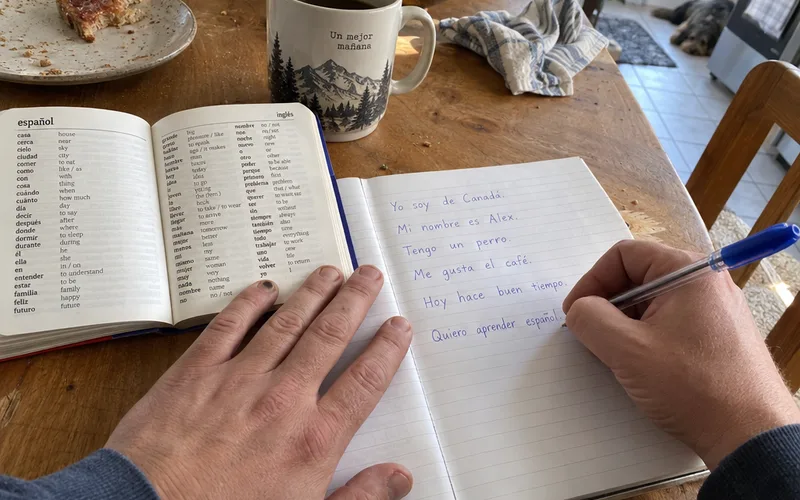
In fact, A1 reading quizzes on Trivia Lingua’s product page stick to very short sentences and the 500 most common Spanish words. The A1 Spanish syllabus lists the grammar this level covers.
A2 Spanish (Elementary)
A2 Spanish handles routine tasks like shopping and asking for directions. You can also talk about the past simply: “El sábado fui al cine con mis amigos.”
B1 Spanish (Intermediate)
B1 Spanish is where you get by on your own, talking about trips, plans and opinions. You’ll still pause to find words, and many learners stall here because B2 needs far more listening and reading.
B2 Spanish (Upper Intermediate)
B2 Spanish means you can talk with native speakers without strain on either side. You can defend an opinion and follow the news on topics you know.
C1 Spanish (Advanced)
C1 Spanish is precise enough for university courses, meetings and skilled jobs. You catch implied meaning and adjust your tone.
C2 Spanish (Mastery)
C2 Spanish is the top of the scale. You understand nearly everything, including irony and regional accents.
Which Spanish CEFR Level Counts as Fluent?
B2 is the Spanish CEFR level most learners and schools call fluent, while B1 is the usual mark for conversational Spanish. C2 is the highest level, but it still isn’t the same as being a native speaker.

The difference shows up in real time: at B1, unfamiliar topics slow you down, while at B2 you keep up with native speakers. Since fluency means different things to different people, check how fluency is defined and how long Spanish takes before you set a target.
What Spanish Level Do You Need?
The Spanish level you need depends on your goal: about A2 to B1 for travel, B1 to B2 for living abroad, and B2 to C1 for working or studying in Spanish. Spanish schools commonly give guidance like this:
| Your goal | Level to aim for |
|---|---|
| Travel | A2 to B1 |
| Living abroad | B1 to B2 |
| Working in Spanish | B2 to C1 |
| University in Spain | B2 to C1 |
Treat these as starting points, then check the exact level your school or employer asks for. Many universities in Spain ask for B2 or C1.
DELE vs SIELE: Which Exam Proves Your Spanish Level?
DELE diplomas and the SIELE exam are the two main tests that prove a Spanish CEFR level, and both are backed by Instituto Cervantes, Spain’s official Spanish-language institute. The DELE certifies one fixed level for life, while the SIELE gives you a single score that comes with an expiry date.
Here’s how they differ:
- DELE diplomas come in A1 through C2. You pick one level, pass it and keep the diploma.
- SIELE is a digital exam you book almost any day. Your score maps to A1 through C1, with no C2.
So if you need a permanent credential, I recommend the DELE. For a fast result on one application, the SIELE fits better, and the right proficiency test for other goals may be neither.
How to Find Your Spanish CEFR Level
The quickest way to find your Spanish CEFR level is a free online placement test, followed by a real-life check against each level’s can-do list. The test gives you a level fast, and the self-check tells you if it matches what you can do.
For example, Cervantes Escuela Internacional’s own page for its free Spanish level test lists 53 questions and about 10 minutes. It places you from A1 to C1, so it can’t confirm C2.
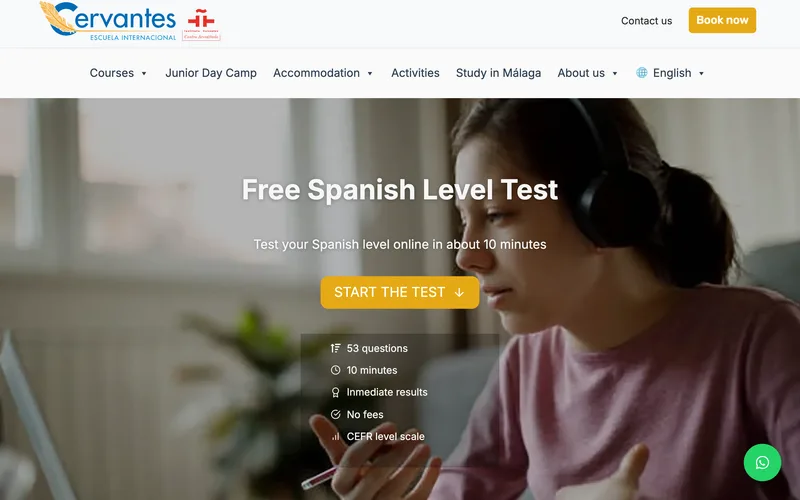
Next, watch a Spanish show without subtitles for 5 minutes. If you follow the main thread but miss details, you’re likely around B1, and if you catch the jokes, you’re likely B2 or higher.
App scores work differently, so check Duolingo’s CEFR estimates before you trust one.
Stuck at B1? Comprehensible input in Spanish builds the listening volume B2 needs.
Do US Tests Use CEFR Levels for Spanish?
US tests often use their own scales, like ACTFL in schools or the Interagency Language Roundtable (ILR) scale in government, but many can report a CEFR level too. ALTA Language Services says there is no single global standard for measuring language performance.
That’s why the company’s testing page says it can report results on its own scale, the ILR scale, the CEFR or a custom scale. So before you test, send this: “Which proficiency scale and minimum level do you need, and which tests do you accept?”
Schools often use STAMP test Spanish scores, and colleges may give credit through the CLEP Spanish exam. On a resume, list your Spanish level with the scale name.
Your Next Step
B2 is the level most learners mean by fluent Spanish.
Take a free placement test this week, then pick your next target level and the exam that will prove it.
Frequently Asked Questions
Is B2 fluent in Spanish?
Yes, B2 Spanish is fluent enough for most real-life goals. A B2 speaker can follow native speakers and argue a point without strain, even if their Spanish isn’t perfect.
Is C2 Spanish fluent?
Yes, C2 is the highest CEFR level and fully fluent Spanish, but it isn’t the same as being a native speaker. Native speakers also carry cultural knowledge picked up from childhood.
What CEFR level is conversational Spanish?
B1 is the CEFR level for conversational Spanish. At B1 you can chat about familiar topics and handle most travel situations, mistakes and all.
Does the DELE expire?
No, a DELE diploma does not expire. That’s the main difference from the SIELE, whose results come with an expiry date.