One AP score of 3 can clear the whole language half of the seal in Hawaii.
The Hawaii State Department of Education lists it right beside IB exams, Avant scores and 2 speaking and writing tests.
But the English half, the deadlines and even whether your school takes part can still trip you up.
So here are the Seal of Biliteracy requirements piece by piece: the 2 proofs, the tests that count, 3 state rulebooks and how to apply.
What Are the Seal of Biliteracy Requirements?
The Seal of Biliteracy requirements come in 2 parts: proof of English and proof of at least one other language by high school graduation. Your state, and sometimes your district, decides which grades, tests and scores count.
That split matters because each half is checked on its own.
Ace your Spanish exam but miss the English mark, and you don’t get the seal.

The seal began in California in 2008 and became a state award there in 2011, per Wikipedia’s encyclopedia entry. As of 2026, all 50 states and the District of Columbia offer a state version, the same entry notes.
In other words, there’s no single national rulebook.
Here’s what the requirements look like across the state rules covered in this guide:
- English: your English Language Arts (ELA) grades, an English test score, or an English proficiency score if you’re an English learner
- Second language: a passing score on an approved test, or a portfolio where your state allows one
- All 4 skills: speaking, listening, reading and writing in that second language
- Graduation: the award goes on your diploma or transcript when you finish high school
Treat the seal as 2 separate checklists, and work on both at the same time.
Who Issues the Seal of Biliteracy?
The State Seal of Biliteracy is issued through your state and your public school district. Wikipedia’s entry notes that private school students are generally not eligible.
Your district also has to choose to take part, and that point is easy to miss.

Arizona’s seal law, as posted by the Global Seal of Biliteracy, says any district or charter school “may voluntarily participate” by notifying the state. So a public school student in a district that never signed up can’t earn that state’s seal through school.
The first requirement isn’t a test at all: it’s a school that offers the seal.
Here’s what to ask before anything else:
- Does our district award the State Seal of Biliteracy?
- Who runs the program at my school?
- Where’s the list of accepted tests and scores?
No program at your school, or you’re in a private school or out of high school? The Global Seal of Biliteracy is your backup route.
The English Requirement: Grades or a Test Score
You meet the Seal of Biliteracy’s English requirement with your English Language Arts (ELA) grades or one English test score. English learners can use an English proficiency score instead.
The exact bar depends on your state, and Arizona shows how strict it can get.
Under the state’s seal statute, you need every ELA class required for graduation with a 2.0 GPA or higher. You must also pass the state’s ELA end-of-course exams.
Both count, not one or the other.

Hawaii works the other way around.
The Hawaii State Department of Education lets you choose any one English option from a list. Here’s what it accepts:
- A 3.0 cumulative GPA in required ELA courses
- A 3 or above on the grade 11 Smarter Balanced ELA test
- A 3 or above on the AP English Language and Composition exam
- A 4 or above on the IB English Language Arts exam
- At least 480 on SAT Reading/Writing
- At least 18 on ACT English
Say your English GPA is 2.8, just short of Hawaii’s 3.0, in this hypothetical. A 480 on SAT Reading/Writing would still cover the English half there.
In Arizona, that same 2.8 clears the 2.0 bar, but you’d still have to pass the end-of-course exams.
Illinois sets SAT 480 as its English requisite, according to the Global Seal’s summary of the state program.
English Learners Have Their Own Route
If English is your second language, you usually prove it with an English proficiency test instead of ELA grades. Hawaii accepts an overall score of at least 4.5 on the ACCESS for ELLs exam.
Illinois uses ACCESS 3.5 or WIDA 4.8, per the same Global Seal summary.
Arizona’s law asks students whose primary language isn’t English for a score of proficient or higher on the state’s English language proficiency standards.
Here’s how that can play out, in a hypothetical:
Say you moved to Illinois in 9th grade and speak Vietnamese at home. Your English could count through ACCESS, and your Vietnamese through a test or a portfolio.

If you’re an English learner, ask which English test your state counts, because it may be easier than the ELA route.
The World Language Requirement: What Level You Need
The Seal of Biliteracy’s world language requirement is a set level on ACTFL’s proficiency scale, shown in speaking, listening, reading and writing. Hawaii sets it at Intermediate Mid, and Illinois sets the full seal at Intermediate High.
ACTFL is the American Council on the Teaching of Foreign Languages, and its scale splits each band into Low, Mid and High.
That’s why you’ll see scores like Intermediate Low, Intermediate Mid and Intermediate High in seal rules. If those labels are new to you, start with how ACTFL proficiency levels work, then come back to your state’s number.
The 4 skills part is just as important as the level.
Illinois’ rule wants a test that covers “the four domains of speaking, writing, listening and reading.” That’s from the Global Seal’s copy of the rule.
In Hawaii, the speaking and writing tests and the Avant exam must be passed in each domain, not on average.

What does that mean for you?
Speaking well at home isn’t enough on its own, because the seal also tests reading and writing. That’s the “literacy” in biliteracy.
Seal vs. Commendation
Some states have 2 award levels.
Illinois gives the full seal at Intermediate High and a Commendation at Intermediate Low, per the Global Seal’s summary. That summary dates the Illinois award to 2013.
So if you test one level short, check whether your state has a lower award you already qualify for.
Which Tests Count for the Seal of Biliteracy?
Tests that count for the Seal of Biliteracy include AP and IB language exams, ACTFL’s speaking and writing tests, Avant’s exam and the ASLPI for sign language. Each one has its own passing score.
Your state publishes the exact list. In Arizona, the state board of education adopts it, according to the state’s seal law.
So never assume a test counts just because a friend in another state used it.
AP and IB Language Exams
Hawaii accepts a 3 or above on an AP language exam or a 4 or above on an IB language exam.
If you’re already in an AP or IB language class, this is often the simplest path. You take the exam anyway, so the seal costs you no extra test.
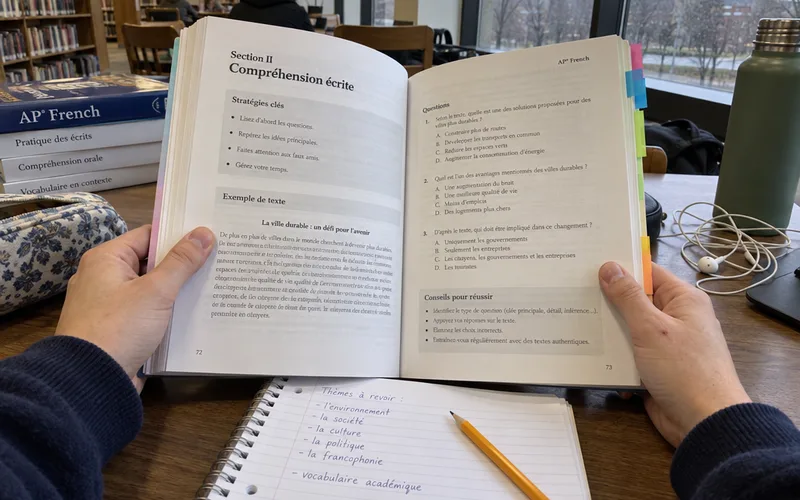
Here’s an example:
Say you’re a junior in AP French and you score a 3 in May. In Hawaii, that score covers the world language half, so your senior year is about meeting the English part and applying on time.
Proficiency Tests: OPI, WPT, Avant and ASLPI
Students who aren’t in an AP or IB class can take a proficiency test instead.
Hawaii lists 3 of them:
- Oral Proficiency Interview (OPI) and Writing Proficiency Test (WPT): Intermediate Mid or above in each domain
- Avant exam: a score of 5 or above in each domain
- American Sign Language Proficiency Interview (ASLPI): a score of 2 or above
Avant’s test is the STAMP. If you test in Spanish, see how Avant STAMP scores map to seal levels before test day.
So which one should you take?
Speak the language at home but never took a class? A speaking-first test like the OPI plays to your strength, and the WPT then checks your writing.
If you’ve been studying it in school, Avant’s exam covers all 4 skills in one sitting, with a score for each.
Not sure which exam fits you? You can compare language proficiency tests by format, cost and the skills each one measures.
Pick the test your school already offers, because your district has to accept and report the score.
What If Your Language Has No Test?
If no standardized test exists for your language, some states let you earn the Seal of Biliteracy with a portfolio of your work instead. Illinois’ rule allows this “alternative evidence method” in 4 cases, according to the Global Seal’s copy of the rule.
Here are those 4 cases:
- You score Intermediate Mid, one level below the Illinois bar, on a standardized test.
- No standardized test exists for your language.
- You have a disability that makes the standard test a bad fit.
- The test for your language skips one of the 4 skills.
This matters for students who speak a language at home that most testing companies don’t cover.
If that’s you, gather proof early: writing samples, recorded talks and any certificates in the language. Rebuilding reading and writing in a family heritage language takes time, so start well before senior year.
Sign language counts too.
The Global Seal’s summary also lists sign language and Latin as accepted in Illinois. Hawaii takes the ASLPI.
Seal of Biliteracy Requirements by State: 3 Real Examples
Seal of Biliteracy requirements by state differ in the English GPA, the accepted tests and even the number of award levels, as Hawaii, Arizona and Illinois show. Here’s how each one sets its rules.
Hawaii
Hawaii’s seal is open to graduating seniors in Hawaii public and charter schools.
You can prove proficiency in English or in ʻōlelo Hawaiʻi, the Hawaiian language, plus a second language. For ʻōlelo Hawaiʻi, the bar is a 3.0 GPA in the Hawaiian Language Arts courses required for graduation.
Applications for the Class of 2027 are due by 3:00 p.m. on November 6, 2026, according to the Hawaii State Department of Education.
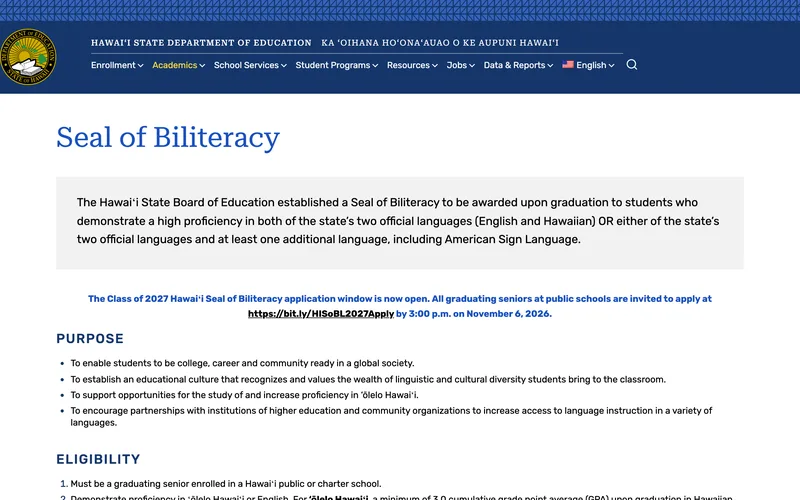
That’s early in senior year.
So if you’re a Hawaii senior reading this in late October 2026, apply this week.
Arizona
Arizona’s seal law, SB 1239, sets a 2.0 ELA GPA, passing ELA end-of-course exams and a passing score on a state-adopted language test.
There’s a catch.
The statute, as the Global Seal posts it, says the program “ends on July 1, 2026.” If you’re in Arizona, ask your district whether the seal is still being awarded before you plan around it.
Illinois
Illinois has 2 awards: the full seal and a lower Commendation.
It also allows the portfolio route and accepts sign language and Latin, which makes it one of the more flexible programs in this guide.
How to Find Your State’s Rules
Your state’s education department posts the official criteria, usually on a page titled with your state’s name and “Seal of Biliteracy.”
Here’s how to find it in a few minutes:
- Search for your state’s name plus “seal of biliteracy accepted assessments.”
- Open the result from your state’s education department, not a test company.
- Download the criteria document or scoring chart it links to.
On that page, look for 3 things:
- The English options and any GPA minimum
- The list of accepted language tests with their cut scores
- The application deadline and who to contact
Also check whether your state has a second award level, like Illinois’ Commendation. A lower tier can turn a near miss into an award.
If you’re in New York, California or Texas, start with your state education department’s seal page. Then confirm the details with your counselor, because districts can add their own steps.
The Global Seal of Biliteracy: For Adults and Private School Students
The Global Seal of Biliteracy is a separate credential for adults, college students and students whose schools can’t join a state program, according to Wikipedia’s entry. It’s the route to take when the state seal isn’t open to you.
That covers 3 common situations:
- You go to a private school that can’t award the state seal.
- Your public district doesn’t take part.
- You’ve already graduated and want proof of your skills.
The Global Seal uses language tests too, so the test prep in this guide still applies.
Before you sign up, check which tests it accepts for your language and what you’ll pay to test. Then pick the test date that fits your schedule, since there’s no senior-year deadline to chase.
Wondering whether the state seal or the Global Seal is the better fit, and what each one gets you? Here’s an honest look at whether the seal is worth it for your situation.
When to Start Working Toward the Seal
Start working toward the Seal of Biliteracy in 9th or 10th grade, because the tests, grades and applications pile up in junior and senior year. Students who learn about the seal late can miss it entirely.
Wikipedia’s entry points to exactly that problem.
The entry notes that many students lacked awareness and preparedness until their senior year, which made them ineligible for the seal.

Here’s a simple plan:
- 9th grade: Confirm your district offers the seal, and plan 4 years of language classes if you can.
- 10th grade: Ask your teacher where you stand on ACTFL’s scale, and note which skill is weakest.
- 11th grade: Take your AP, IB or proficiency test, so you have time to retest a weak skill.
- 12th grade, fall: Check your English route, then submit the application before your school’s deadline.
Hawaii’s November 6 deadline for the Class of 2027 shows how early that final step can land.
Got younger kids? A dual language immersion program builds all 4 skills from elementary school, long before seal season.
How to Apply for the Seal of Biliteracy
To apply for the Seal of Biliteracy, confirm your district takes part, meet the English and second-language requirements, and submit your school’s application before its senior-year deadline. Most of the work happens before the form.
Here’s the step-by-step:
- Email your counselor. Confirm the program, the contact person and the deadline.
- Check your English route. Match your grades or scores to your state’s English options.
- Register for a language test. Use one from your state’s accepted list.
- Send your scores to the school. Make sure the seal coordinator has your official results.
- Submit the application. In Hawaii, seniors apply online.
- Check your transcript. Make sure the seal shows up after graduation.
Here’s what to send your counselor:
“Hi, I’d like to earn the State Seal of Biliteracy in Spanish. Does our district award it, which tests do you accept and when is the application due?”
That one email covers the 3 answers you need before anything else.
If the answer is that your school doesn’t offer the seal, ask whether the district plans to join. If it doesn’t, the Global Seal of Biliteracy is still open to you.
What You Get When You Earn the Seal
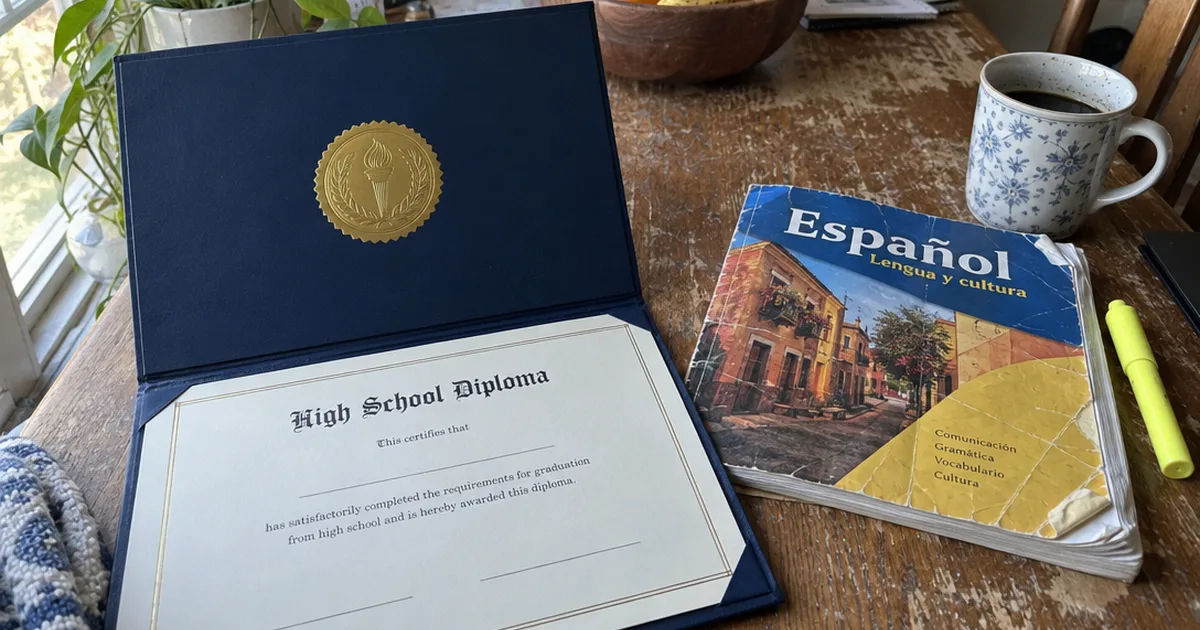
Earning the Seal of Biliteracy puts a designation on your diploma or transcript. Some states add more: Hawaii honorees also get a medallion and a certificate.
Arizona’s seal law places the seal on both the diploma and the transcript.

College credit is possible too.
The Global Seal’s summary of the Illinois program lists college credit as available, though each college sets its own policy. So if credit is your goal, email each college’s language department and ask what the seal earns you there.
The seal also gives you a clear line for applications and jobs. When you list it, add your level using the language proficiency levels on a resume that employers recognize.
If you grew up speaking Spanish at home, remember that home Spanish and tested Spanish aren’t the same. Learn the gaps heritage learners often have in reading and formal writing before test day.
The Bottom Line
The seal comes down to 2 proofs, English and one more language, at the level your state sets.
This week, email your counselor and ask whether your district takes part and which tests it accepts.
Frequently Asked Questions
Is it hard to get the Seal of Biliteracy?
Getting the Seal of Biliteracy is manageable if you can already use the language in all 4 skills, since Hawaii, for example, sets its speaking and writing bar at Intermediate Mid on ACTFL’s scale. Ask your language teacher to estimate your level before you register for a test.
What score do you need to pass the Seal of Biliteracy?
The passing score for the Seal of Biliteracy depends on the test and the state: Hawaii accepts a 3 on an AP language exam, a 4 on an IB language exam or a 5 on Avant’s exam in each skill. Look up your own state’s list, because cut scores differ.
Is the Seal of Biliteracy a national award?
No, the Seal of Biliteracy isn’t one national award, because each state sets its own criteria. All 50 states and the District of Columbia offer a version as of 2026, according to Wikipedia’s entry on the seal.
What's the difference between biliterate and bilingual?
Biliterate means you can read and write in two languages, not just speak and understand them. That’s why Seal of Biliteracy tests check speaking, listening, reading and writing.
Is there a test to prove you are bilingual?
Yes, tests such as ACTFL’s Oral Proficiency Interview and Writing Proficiency Test, Avant’s exam and AP language exams measure your level in a second language. Your state’s seal list tells you which ones count and the score you need.
Can I put the Seal of Biliteracy on my resume?
Yes, you can list the Seal of Biliteracy on your resume under honors or awards, with the language and the year you earned it. Add your proficiency level so employers know what the award means.
Is the Seal of Biliteracy a big deal?
The Seal of Biliteracy is a real honor that goes on your diploma or transcript, and the Global Seal’s summary of the Illinois program lists college credit as available. How much it helps you depends on your colleges and plans, so ask them how they treat it.