Finishing A2 German can take as little as 96 hours of class.
That’s the shortest route on DeutschAkademie’s A2 course page: two 48-hour courses of 4 weeks each.
In other words, A2 can be weeks away, not years.
Here’s what A2 really asks of you, what it costs, and the fastest honest way to get there.
What Is A2 German?
A2 German is the second of the six levels on the Common European Framework of Reference for Languages (CEFR), right after the beginner level A1. It’s still basic German, but it’s where you stop reciting phrases and start handling everyday exchanges on your own.
Schools split the level into 2 halves, A2.1 and A2.2. DeutschAkademie, a school with locations in Germany and Austria, says you finish A2 only after completing both.
Above A2 sits B1, the first intermediate level. These six language proficiency levels work the same in every language.
What You Can Do in German at A2
At A2, German learners can handle routine, familiar tasks in the German language: talking about themselves and their family, shopping, getting around town and simple work topics. One German school’s A2 course goals call these “simple, routine situations” that need a direct exchange of information.
Here’s what those communication skills look like:
- Understanding: common phrases about you, your family, shopping, your area and work.
- Speaking: short conversation about the weather, getting around a city or ordering in a restaurant.
- Describing: your background, education and daily needs, in simple words.
- Writing: short texts and emails, such as a text message or a semi-formal letter.
Can you order dinner and text a coworker in German? Then you’re working at A2.
A1 vs A2 German: What Actually Changes
A2 German builds directly on A1: you keep the A1 grammar, add new sentence structures and grow your vocabulary for everyday life. At A1 you mostly talk about now, and at A2 you start talking about the past and giving reasons.
If you’re still finishing A1 German, wrap that up first. A2 courses expect some knowledge of German already.
Here are the 3 changes you’ll notice first:
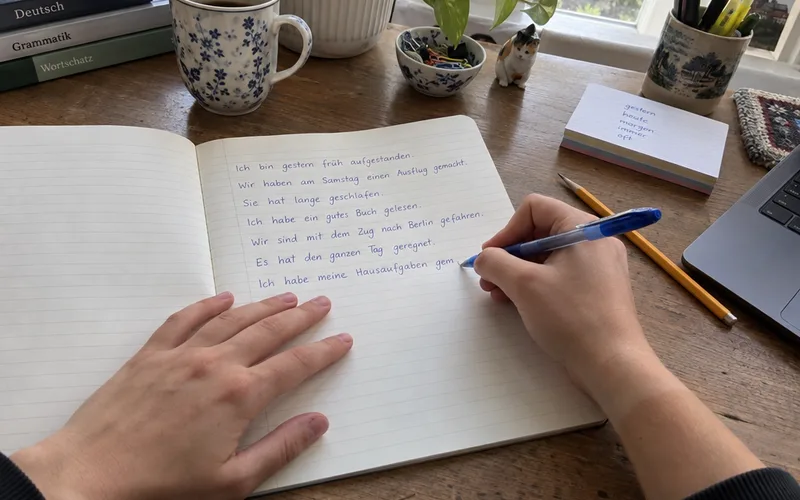
- The past tense. You tell stories with the perfect tense: Ich habe Pasta gekocht (I cooked pasta).
- Longer sentences. Subordinate clauses push the verb to the end, unlike in English: Ich lerne Deutsch, weil ich in Wien arbeite.
- Case endings. Two-way prepositions switch between the accusative case and the dative: in die Küche (into the kitchen) vs in der Küche (in the kitchen).
A2 German Grammar: What’s on the Syllabus
A2 German grammar adds about two dozen topics to A1, from the perfect tense and the Preterite to relative clauses and the Subjunctive. The same school’s A2 course syllabus lists 13 grammar topics for A2.1 and 11 for A2.2.
A2.1: Past Events, Cases and “Weil” Clauses
The first half is about saying what happened and why:
- separable verbs and the perfect tense
- two-way prepositions with the dative or accusative case
- adjective endings before nouns
- the conjunctions weil, obwohl, dass and wenn, with the verb at the end
- the past forms of modal verbs, and könnte and sollte
A2.2: Simple Past, Passive and Polite Requests
The second half adds the Preterite (simple past) and the present passive. You also learn verbs with indirect and direct objects, indirect questions, reflexive verbs and polite requests with würde.
Free courses follow a similar curriculum. Learn German Original’s A2 course runs 50 lessons that also cover the genitive case and the comparative.
Pro Tip: Learn the perfect tense first, since the rest of A2 builds on it.
If the list looks scary, patch your base with a pass through German grammar for beginners.
The Vocabulary Topics A2 Covers
A2 German vocabulary is organized by everyday themes, not a fixed word count. Expect work, family, food and shopping, travel, health, housing, forms and the internet.
Flashcards make this manageable, especially with each word in a short sentence about your life. Shared Anki decks for German save you from building every card yourself.
How Long Does It Take to Reach A2 German?
Reaching A2 German takes about 96 to 144 hours of class after A1 at DeutschAkademie, which teaches the level in two or three 4-week courses. That’s about 8 to 12 weeks at the school’s intensive pace.
The 96-hour route is A2.1 and A2.2, each 48 lessons of 60 minutes. The school says it needs extra discipline outside class.
Its slower route adds an A2+ course, for 144 hours, to lock in the level before B1.
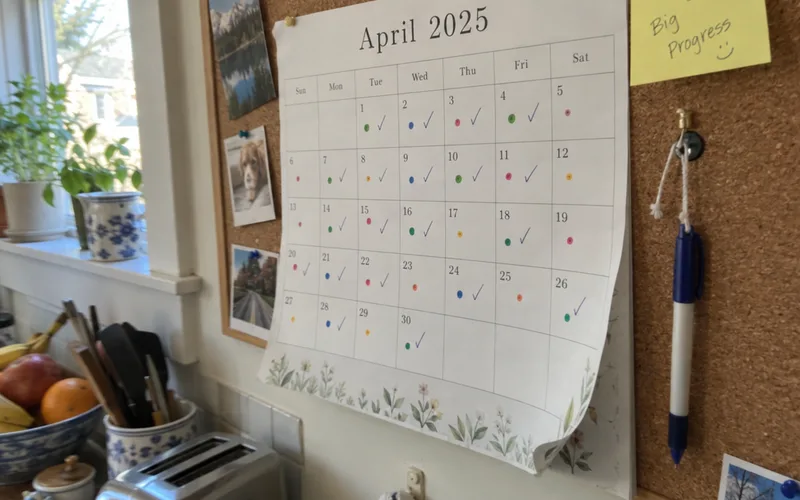
Studying alone at 1 hour a day, 5 days a week? Matching 96 hours would take about 19 weeks.
So in language learning, your weekly hours matter more than the calendar, which is true of how long learning a language takes at any level.
How Much Does an A2 German Course Cost?
An A2 German course at DeutschAkademie starts at €309 for a 4-week online intensive course of 48 hours, with no registration fee. Because A2 takes 2 or 3 courses, the full level starts at about €618 to €927 online.
Here’s the math, assuming each course costs the €309 starting price:
| Route | Class hours | Length | Online cost from |
|---|---|---|---|
| 2 courses (A2.1 + A2.2) | 96 | 8 weeks | €618 |
| 3 courses (adds A2+) | 144 | 12 weeks | €927 |
On-site prices depend on the city, says the same price page. If you need a certificate, budget for the exam fee too.
Which Exam Proves Your A2 German?
Two exams that certify A2 German are the Goethe-Zertifikat A2 from the Goethe-Institut and telc Deutsch A2 from TELC. An official certificate is different from the completion certificate a school hands out.
DeutschAkademie, for example, gives a completion certificate for each A2 course. After the full level, it says you can register for an official exam such as telc Deutsch A2.
What the Goethe-Zertifikat A2 Asks You to Do
Exam-prep courses drill the real tasks. Learn German Original’s course has you plan something together with a partner, as in the speaking part (Sprechen Teil 3).
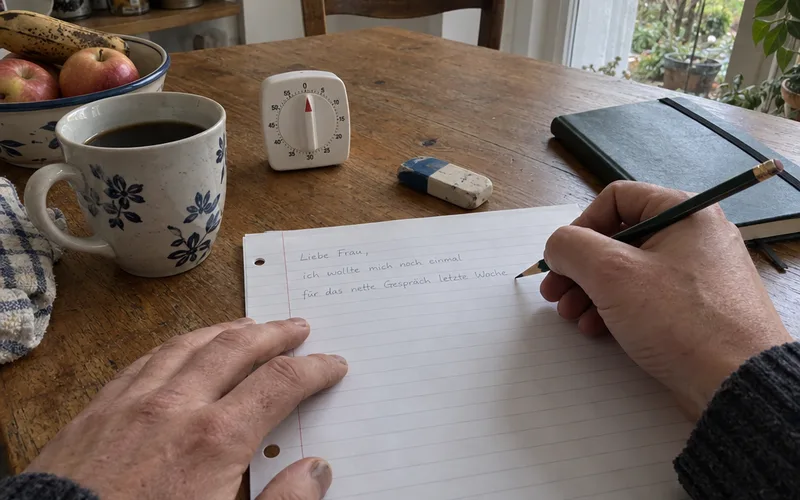
It also practices a semi-formal letter for the writing part (Schreiben Teil 2), so rehearse both tasks.
Note: Ask your test center for its current fee and dates before you book.
Need a certificate for a specific goal? Compare the major proficiency tests first, and app learners can check Duolingo’s CEFR levels.
How to Study for A2 German on Your Own
You can reach A2 German on your own by following a course’s order: a placement test, the syllabus grammar, vocabulary by theme, weekly speaking and lots of listening. Here’s the plan:
- Find your starting point. Take a placement test, so you don’t repeat A1 or skip past gaps.
- Follow the syllabus order. A coursebook keeps you on track, and these German books from A1 to B2 cover the whole path.
- Learn words by theme. Do one theme a week with flashcards.
- Speak every week. Try these German speaking practice ideas, and rehearse exam tasks with a partner to build confidence.
- Listen and read a lot. Podcasts, shows with German subtitles and simple articles build your listening and reading comprehension.
That last step is the one a textbook can’t do for you: it trains your ears, and your pronunciation, on native speakers.
Stuck at A2? How to Push Toward B1
Getting unstuck at A2 German means consolidating the level before you rush into B1, with more speaking and more German you can follow. That’s the job of the optional A2+ course: it expands the level so the move to B1 gets easier.
On your own, retell your day out loud in the perfect tense, and get feedback from a tutor on your mistakes.
Above all, listen and read more. Comprehensible input in German builds fluency by turning the rules you know into German you can use without thinking.
Your Next Step
A2 is the milestone where German starts working for you in everyday life.
This week, take a placement test, then plan your A2.1 grammar topics around the result.
Frequently Asked Questions
Can I reach A2 German in 3 months?
Yes, if you’ve already finished A1 and can study intensively: DeutschAkademie teaches A2 in two 4-week courses, about 8 weeks and 96 hours of class. Its slower 3-course route takes about 12 weeks, which still fits inside 3 months.
Can I write German A2 without A1?
You can start an A2 course without an A1 course if a placement test shows you’re ready. DeutschAkademie says learners should ideally finish A1 first, but it places students with a free placement test, so take one before you book.
Is German A2 difficult?
German A2 is harder than A1 mainly because of grammar: DeutschAkademie’s A2 syllabus lists 24 grammar topics across A2.1 and A2.2, including the perfect tense, adjective endings and subordinate clauses. Its faster 96-hour route also expects extra study outside class.