
Most language family trees look impressive and teach you almost nothing. You stare at hundreds of branches and still can’t say why Spanish feels easy and Finnish feels impossible.
In this guide, I’ll show you how to read the tree in a few minutes, and how to use it to choose what to learn.
Here’s a quick picker:
- Want to know where English sits? Jump to the Indo-European section.
- Choosing a language to learn? Go to the section on picking a language.
- Need a full chart or poster? Skip to the sources near the end.
Let’s dive right in.
What a Language Family Tree Actually Shows
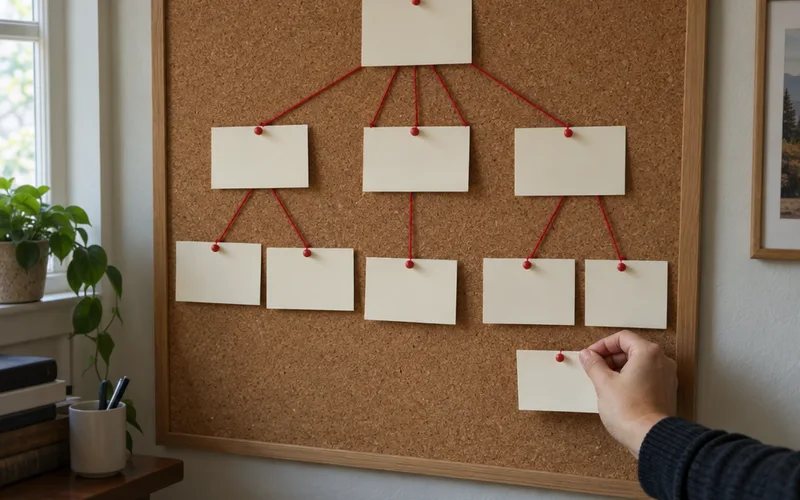
A language family is a group of languages that grew out of one shared ancestor, called a proto-language. On a tree of language families, that ancestor is the trunk, and each language that split off from it is a branch.
So two languages on the same branch are relatives, not just neighbors. The tree shows shared ancestry and nothing else, so it won’t tell you how many people speak a language or how hard it is.
How to Read a Language Family Tree in 4 Steps
Here’s the process I’d use on any tree, including Minna Sundberg’s drawing listed near the end:
- Find your language. Start at the tip of a branch, not the trunk.
- Move up one level. That point is your branch, such as Slavic or Romance.
- Look sideways. The languages on the same branch are your closest relatives.
- Check the line style. Dashed lines, question marks or a different color usually mark a disputed link.
That last step matters most. A solid line means the link is settled, while a dashed one is only a theory.
Where English and Other Indo-European Languages Sit
English belongs to Indo-European, the family that covers most of Europe and much of South Asia. It also holds most of the languages US learners pick first.
Germanic Languages
The English language sits on the Germanic languages branch, with German, Dutch, Swedish, Norwegian and Danish. English, Dutch and German share a smaller twig called West Germanic.
That’s why basic words line up so well. Compare English “water” with Dutch “water” and German “Wasser.”
Romance Languages
The Romance languages grew out of the spoken Latin of the Roman Empire. Spanish, Portuguese, French, Italian and Romanian all sit on this branch.
Latin is no longer anyone’s first language, but it never fully vanished. That’s why people still argue over whether Latin is a dead language.
Slavic and Indo-Iranian Languages
The Slavic languages include Russian, Polish, Czech and Bulgarian. They share a lot of grammar, so one gives you a head start on the others.
Further east, the Indo-Iranian languages include Hindi, Urdu, Bengali and Persian. Hindi and Urdu are so close in everyday speech that speakers often understand each other, even with different scripts.
Not all Indian languages are on this branch, though. Tamil and Telugu belong to a separate family, Dravidian.
The Other Major Language Families
Here are the other families you’ll see on almost every full chart:
- Sino-Tibetan: Mandarin, Cantonese, Tibetan and Burmese.
- Afro-Asiatic: Arabic, Hebrew, Amharic and Somali.
- Niger-Congo: Swahili, Yoruba and Zulu.
- Austronesian: Indonesian, Malay, Tagalog and Hawaiian.
- Dravidian: Tamil, Telugu and Kannada.
- Turkic: Turkish, Kazakh and Uzbek.
- Uralic languages: Finnish, Estonian and Hungarian.
A few languages fit none of these. Japanese and Korean each sit in their own small family, and Basque has no known relatives at all.
That Uralic branch solves the Finnish puzzle from the intro. Finnish is spoken in Europe but isn’t Indo-European, so an English speaker gets almost no free vocabulary from it.
How Linguists Know Languages Are Related
Linguists compare basic words and grammar, then work backward to the ancestor. Take “father”: Latin has “pater,” Sanskrit has “pitar” and English has “father.”
Those matches follow regular sound patterns, and that’s what proves shared descent. One lookalike word proves nothing, because languages borrow words all the time.

Grammar has the same catch. The encyclopedia entry on Ural-Altaic notes that shared features alone aren’t enough to prove two languages are related, since other explanations are possible.
The big idea is old, too. The same entry says Gottfried Wilhelm Leibniz wrote in 1710 that every human language comes from one ancestor.
Disputed Branches Worth Knowing About
Two long-shot branches show up on many popular charts:
- Altaic: groups Turkic, Mongolic and Tungusic.
- Ural-Altaic: adds the Uralic languages to that group.
The encyclopedia entry says linguists generally accepted the Altaic family until the 1960s, and it has been disputed since. Most now see the shared features as borrowing between neighbors.
Ural-Altaic has fared even worse. The same entry reports that the idea of Uralic and Altaic as close relatives has almost no adherents today.
Note: If a chart draws these links with solid lines, treat the rest of it with the same caution.
Use the Tree to Pick a Language You’ll Learn Faster
Here’s the deal: the closer a language sits to yours, the faster you’ll usually reach your first real conversation. Shared roots mean shared words, similar grammar and fewer new sounds.
For an English speaker, that points to two starting zones. Germanic sisters like Dutch and Norwegian share core words, and Romance languages share the many words English took from French and Latin.
Your first step: find your native language on the tree and list the three nearest branch tips. Then check that list against the closest languages to English, or the closest languages to Spanish if you already speak Spanish.
Close relatives can still trick you. Dutch and German look alike on paper, yet Dutch is not German, and treating one as a shortcut to the other is a classic mistake.

Distance also explains difficulty. Languages from other families top most language difficulty rankings for English speakers, while the easiest languages to learn mostly sit nearby.
Pro Tip: Before you commit, watch one episode of a show in each language on your list. Learning from TV shows with dual subtitles shows you how much you already understand.
Where to Find a Full Language Family Tree
These free sources each do a different job:
- Glottolog: a free online catalog of the world’s languages. Use it to look up where one language sits.
- Minna Sundberg’s tree: a famous drawing of Indo-European and Uralic languages. Use it to see the big picture at a glance.
- Wikipedia: each family has its own page with a branch diagram. Use it to go one level deeper.
Keep one limit in mind: trees work best for clean splits, so they struggle with creole languages and with dialects that blend into each other.
That’s where the line between a dialect and a language gets blurry.
Your Next Step
A language family tree is a map of shared roots. Find your own branch first, then look sideways for the languages that will feel familiar.
Then use that shortlist when you work through choosing a language to learn.
Which branch are you going to explore first?
Frequently Asked Questions
What are the major language families?
There’s no official list, so lists of five, seven or eight just stop at different points. Most start with Indo-European, Sino-Tibetan, Niger-Congo, Afro-Asiatic and Austronesian.
Is there a language family tree?
Yes, though there’s no single official one. Start with Glottolog, a free online catalog, then use an illustrated tree for the big picture.
Who are the ancestors of Indo-Europeans?
Linguists trace the family to Proto-Indo-European, a language rebuilt by comparing its daughters, because no one wrote it down. Where its speakers lived is still debated.
Are Dutch and German in the same language family?
Yes. Both are West Germanic languages, which also makes them close cousins of English.
How many languages are in the Indo-European family?
Hundreds, spread across branches like Germanic, Romance, Slavic and Indo-Iranian. The exact count depends on how a catalog separates languages from dialects.
What are the 3 hardest languages in the world?
There’s no fixed top three, because difficulty depends on your native language. For English speakers, languages from other families, like Japanese, Korean or Arabic, usually take longest.