
Spanish has 115 million more native speakers than English.
That gap comes from Ethnologue’s 2026 counts: 487 million for Spanish, 372 million for English.
So why does almost every list crown English the most spoken language in the world?
It comes down to who you count. Below you’ll get the full 2026 ranking, the reason English still wins, and a plain way to read any language list without getting fooled.
What Is the Most Spoken Language in the World?
English is the most spoken language in the world when you count everyone who speaks it, native and second-language speakers together. Mandarin Chinese is the most spoken language by native speakers, with 988 million people who learned it first.
Both answers are right.
They just answer two different questions.
The first question is “How many people can use this language?” That’s total speakers, and English wins it because hundreds of millions of people learn it in school, at work and online.
The second question is “How many people grew up speaking this language?” That’s native speakers, also called first-language speakers, and Mandarin Chinese wins it by a mile.
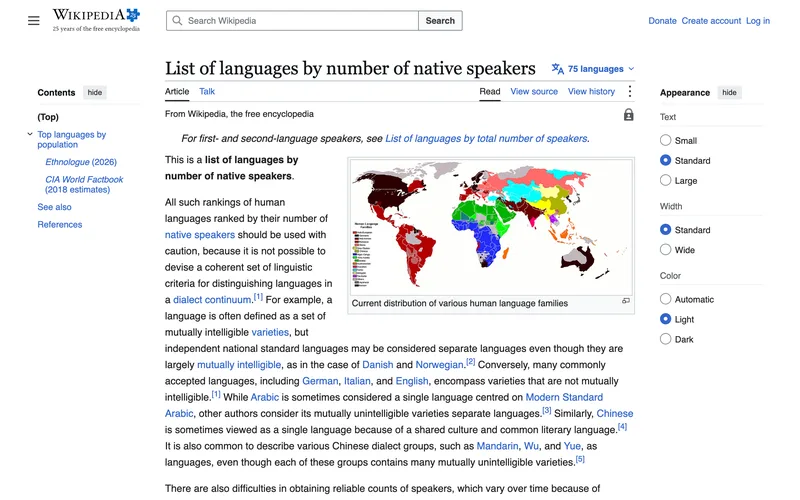
In fact, the 2026 native speaker counts in Wikipedia’s reference list put Mandarin at 988 million, more than 2.5 times English’s 372 million.
So when someone asks which language is the most spoken, the honest answer always starts with “counted how?”
Native Speakers vs Total Speakers
Native speakers learned a language as their first language in childhood, while total speakers add everyone who learned it later as a second language. That difference flips the top of every ranking, because English has relatively few native speakers but an enormous number of learners.
Here’s how the two groups break down:
- Native speakers (first language, or L1): people who grew up with the language at home.
- Second-language speakers (L2): people who learned it later, usually in school or for work.
- Total speakers: both groups added together.
A language with a huge home population, like Mandarin in China, piles up native speakers.
A language that the world uses to talk across borders piles up second-language speakers instead.
English is the clearest example. In its 2023 overview, Middlebury Language Schools notes that English ranks third by native speakers, at about 379 million.
Yet it’s the lingua franca of business, science, aviation, computing and diplomacy.
A lingua franca is a shared language. People with different first languages use it for everyday communication.
Here’s a made-up example to show how much the counting rule matters. Say Language A has 100 million native speakers and almost no learners, while Language B has 60 million native speakers and 150 million learners.
On a native list, A wins easily. On a total list, B wins with 210 million speakers to A’s 100 million.
If you grew up with a family language and learned English as a second language at school, you sit in both groups at once. The line between a native and a heritage speaker can get blurry too, which is one more reason speaker counts are estimates, not head counts.
The Top 10 Languages by Native Speakers in 2026
Mandarin Chinese leads the top 10 languages by native speakers in Ethnologue’s 2026 figures, with 988 million. Spanish, English, Hindi, Portuguese, Bengali, Russian, Japanese and Western Punjabi follow, and Turkish ties Vietnamese for 10th.
Here’s the full top 10, with each language’s family. The notes on where each language is official come from Middlebury Language Schools’ 2023 overview:
| Rank | Language | Native speakers | Language family |
|---|---|---|---|
| 1 | Mandarin Chinese | 988 million | Sino-Tibetan |
| 2 | Spanish | 487 million | Indo-European |
| 3 | English | 372 million | Indo-European |
| 4 | Hindi | 347 million | Indo-European |
| 5 | Portuguese | 252 million | Indo-European |
| 6 | Bengali | 232 million | Indo-European |
| 7 | Russian | 133 million | Indo-European |
| 8 | Japanese | 124 million | Japonic |
| 9 | Western Punjabi | 90 million | Indo-European |
| 10 | Turkish / Vietnamese | 86 million each | Turkic / Austroasiatic |
Mandarin alone has more native speakers than Spanish and English combined: 988 million vs 859 million.
Notice that 7 of the 10 belong to one family, Indo-European. And look at the drop after 6th place: Russian has less than 60% of Bengali’s native speakers.
Now let’s go through each language, starting at the top.
1. Mandarin Chinese (988 Million Native Speakers)
Mandarin Chinese has 988 million native speakers, more than any other language on Earth. It belongs to the Sinitic branch of the Sino-Tibetan family.
It’s the official language of China and Taiwan and is widely spoken in Singapore.
Its size comes almost entirely from China’s population. That’s also why it ranks lower on total-speaker lists: far fewer people learn it as a second language than learn English.
Curious if it’s worth learning? A Mandarin course for beginners is a low-risk way to test your interest before you commit to learning it.
2. Spanish (487 Million Native Speakers)
Spanish has 487 million native speakers, the second-largest native population in the world. It’s a Romance language in the Indo-European family.
Spanish is the official or national language in 21 countries, including Spain, Mexico and most of Central and South America.
It also has a close cousin in the top 5. Portuguese, another Romance language, adds 252 million native speakers.
For US readers, that’s a big deal.
Of the top 3 native languages, Spanish is the one you can practice with neighbors, coworkers and TV shows without leaving the country. It also opens up a huge world of music and literature.
3. English (372 Million Native Speakers)
English has 372 million native speakers, third behind Mandarin and Spanish. It’s a Germanic language in the Indo-European family.
It’s the first language of countries like the United States and the United Kingdom. It’s also widely learned by adults and kids around the world.
That second part is the whole story. English’s native count is modest, but its learner count is what pushes it to first place overall.
English is the only top-3 language whose ranking depends almost entirely on people who didn’t grow up speaking it.
4. Hindi (347 Million Native Speakers)
Hindi has 347 million native speakers, just 25 million behind English. It belongs to the Indo-Aryan branch of Indo-European.
Hindi is one of India’s 22 scheduled languages, used in government, media and education.
That official role keeps Hindi in daily use across India, the biggest country in South Asia.
5. Portuguese (252 Million Native Speakers)
Portuguese has 252 million native speakers, making it the fifth most spoken native language. It’s a Romance language, a close cousin of Spanish.
Portugal, Brazil and Angola are among the countries where it’s official.
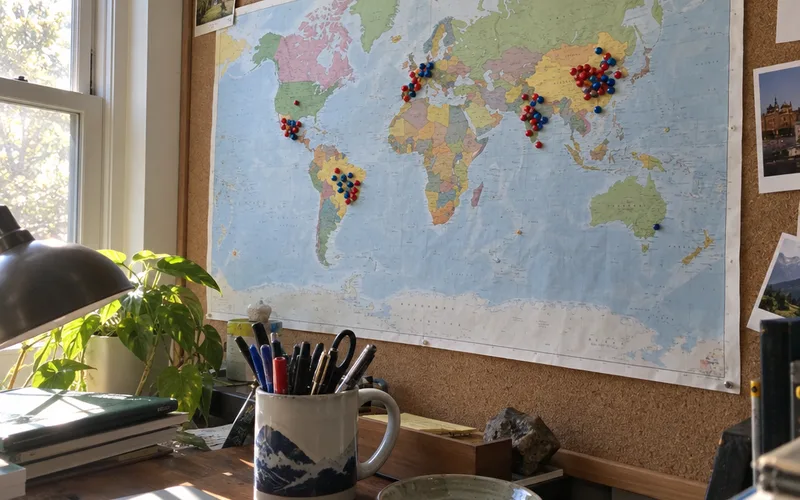
That spread across Europe, South America and Africa is unusual for a language its size.
6. Bengali (232 Million Native Speakers)
Bengali has 232 million native speakers. Like Hindi, it’s an Indo-Aryan language.
It’s the official language of Bangladesh and another of India’s 22 scheduled languages.
Bengali rarely shows up on “languages to learn” lists in the US. Yet it has almost 100 million more native speakers than Russian.
7. Russian (133 Million Native Speakers)
Russian has 133 million native speakers. It’s a Balto-Slavic language, part of the Indo-European family.
It’s the official language of Russia and one of the 6 official languages of the United Nations.
That UN seat gives Russian a diplomatic weight bigger than its 7th-place native count suggests.
8. Japanese (124 Million Native Speakers)
Japanese has 124 million native speakers and sits in its own family, Japonic. It’s spoken mainly in Japan.
That makes Japanese the most “concentrated” language in the top 10.
Almost everyone who speaks it natively lives in one country, so its ranking tracks Japan’s population closely.
9. Western Punjabi (90 Million Native Speakers)
Western Punjabi has 90 million native speakers. It’s an Indo-Aryan language, also called Lahnda, spoken mainly in Pakistan.
Most US learners have never heard of it. That’s a good reminder that the biggest languages aren’t always the ones taught in American schools.
10. Turkish and Vietnamese (86 Million Native Speakers Each)
Turkish and Vietnamese tie for 10th place with 86 million native speakers each. Turkish belongs to the Turkic family and Vietnamese to the Austroasiatic family.
Neither one is Indo-European, which makes them 2 of only 4 non-Indo-European languages in the top 10.
The Next 11 Languages by Native Speakers
The next 11 languages by native speakers in the 2026 figures each have between 76 million and 85 million. Yue Chinese tops this group, and French and Standard German close it.
Here’s that next tier:
- Yue Chinese (Cantonese): 85 million
- Egyptian Arabic: 83 million
- Wu Chinese: 83 million
- Marathi: 83 million
- Telugu: 83 million
- Korean: 82 million
- Tamil: 79 million
- Urdu: 78 million
- Indonesian: 78 million
- Standard German and French: 76 million each
French is the surprise here. It sits near the bottom of this list, yet total-speaker rankings place it much higher, because so many people learn the French language later in life.
Korean is worth a look too. It has 82 million native speakers, about two-thirds of Japanese’s 124 million, so the two languages are closer in size than many learners expect.
In other words, the further down the native list you go, the more the second-language count can reshuffle the order.
Languages With 50 to 75 Million Native Speakers
7 more languages have over 50 million native speakers in the 2026 figures. Javanese leads this group with 69 million, and Bhojpuri closes it at 53 million.
Here’s the rest of that list:
- Javanese: 69 million
- Iranian Persian: 65 million
- Italian: 60 million
- Hausa: 58 million
- Gujarati: 58 million
- Levantine Arabic: 55 million
- Bhojpuri: 53 million
That brings the 50-million club to 29 languages.
Italian is the one most US learners will recognize. Yet Hausa, a Chadic language, has 58 million native speakers, almost as many as Italian’s 60 million.
So if you want a big language that few Americans study, this tier is where to look.
Why English Has the Most Total Speakers
English has the most total speakers because it’s the world’s lingua franca: the shared language of business, science, aviation, computing and diplomacy, per Middlebury. Hundreds of millions of people learn it as a second language.
Why does that matter?
Because a language spreads through what people need it for.
Native counts grow with birth rates. Learner counts grow with globalization: jobs, international trade, school systems, travel, technology and the internet.
English gets a boost from all of those at once, so it keeps adding speakers who never use it at home.
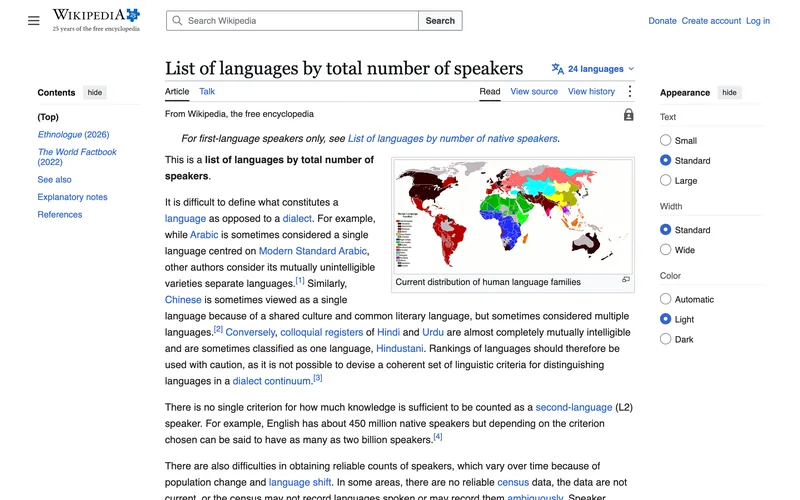
The numbers show how lopsided this is. The CIA World Factbook’s 2018 estimates put English as a first language at just 5.1% of the world’s population.
That’s the same share as Arabic.
So English isn’t the biggest because more people are born into it.
It’s the biggest because more people choose it.
What does that mean for you?
If you already speak English, you have the world’s widest-reaching language covered. A second language is how you reach the people who use something else at home, and the native list shows where they are.
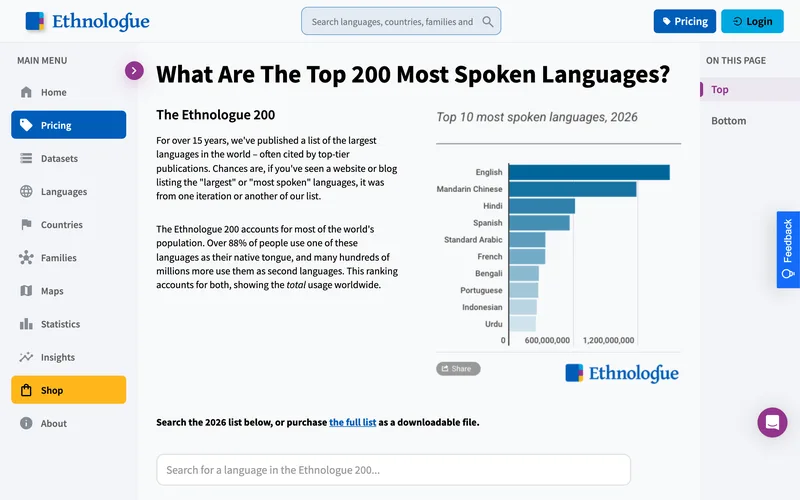
Note: This article sticks to native counts for exact figures. For current total-speaker estimates, check the free top 200 list on the Ethnologue website, which updates with each edition.
What Is the Second Most Spoken Language in the World?
Spanish is the second most spoken language in the world by native speakers, with 487 million in the 2026 figures. By total speakers, Mandarin Chinese takes second place behind English.
That flip trips up a lot of people.
Here’s the deal:
- By native speakers: Mandarin 1st, Spanish 2nd, English 3rd.
- By total speakers: English 1st, Mandarin 2nd.
So “after English” usually means Mandarin. And “after Mandarin” on a native list means Spanish.
And the 3rd, 4th and 5th spots? By native speakers they go to English, Hindi and Portuguese, in that order.
Pro Tip: If a quiz asks for the most spoken language, answer “English” and add “by total speakers.” If it asks about native speakers, the answer is Mandarin Chinese.
What Share of the World Speaks Each Language?
Mandarin Chinese is the first language of 12.3% of the world’s population, about 1 in 8 people, according to the CIA World Factbook’s 2018 estimates. Spanish follows at 6.0%, then English and Arabic at 5.1% each and Hindi at 3.5%.
Percentages are a handy way to feel the scale.
Here’s the full CIA top 11 by share of the world:
- Mandarin Chinese: 12.3%
- Spanish: 6.0%
- English: 5.1%
- Arabic: 5.1%
- Hindi: 3.5%
- Bengali: 3.3%
- Portuguese: 3.0%
- Russian: 2.1%
- Japanese: 1.7%
- Western Punjabi: 1.3%
- Javanese: 1.1%
Put another way, only about 1 person in 20 grew up speaking English.
That’s the same share as Arabic, and less than half of Mandarin’s.
Keep in mind these are 2018 estimates, published in a 2023 Factbook update and cited in Wikipedia’s list. They’re older than the 2026 counts and they group Arabic as one language, so the order won’t match every other list.
Why Speaker Numbers Differ Between Sources
Speaker numbers differ between sources for 3 reasons: where each one splits languages from dialects, which year its data comes from, and whether it counts native or total speakers. Wikipedia’s reference list warns that no single rule splits languages along a dialect continuum, so native rankings need care.
A dialect continuum is a chain of related varieties where neighbors understand each other but the ends of the chain don’t.
Where you cut that chain changes the count.

Dates matter too. Middlebury’s 2023 overview lists Mandarin at “more than 918 million” native speakers, while the 2026 figures say 988 million.
Neither is wrong. They come from different editions.
Even the order can flip. The CIA’s 2018 shares put Bengali (3.3%) just ahead of Portuguese (3.0%), while the 2026 native counts put Portuguese ahead, 252 million to 232 million.
Grouping matters most of all. The CIA’s 2018 shares put Arabic, the main language of the Arab world, 4th, at 5.1% of the world, while the 2026 native table doesn’t list Arabic at all.
Here’s why.
Why Arabic Isn’t on Native-Speaker Lists
Arabic is missing from the 2026 native-speaker table because Ethnologue treats it as a macrolanguage, a group of related varieties, not one language. Wikipedia’s reference list notes the same rule leaves out Chinese, Persian, Malay, Pashto and Lahnda as single entries.
Instead, the 2026 table lists the big varieties separately.
Egyptian Arabic shows up at 83 million native speakers and Levantine Arabic at 55 million.
Modern Standard Arabic is the shared form for writing, news and formal speech across the Middle East and North Africa, but people grow up speaking a local variety at home. If you’re curious how far apart those varieties get, the question of whether Egyptian counts as a language is a good place to start.
Is Chinese One Language?
Chinese is often treated as a group of related languages, not one, because speakers of Mandarin, Yue (Cantonese) and Wu often can’t understand each other. So the 2026 figures list Mandarin (988 million), Yue (85 million) and Wu (83 million) as separate entries.

What holds them together is a shared culture and a common written language built on Chinese characters. Add those 3 together and “Chinese” would top any list by an even wider margin.
The dialect vs language question is exactly what makes these tables so slippery.
How to Check a Language Ranking Yourself
You can check any language ranking in about 5 minutes by confirming 4 things: what it counts, which year its data comes from, how it groups Arabic and Chinese, and where its numbers come from. Most disagreements between lists disappear once you line those up.
Here’s how to do it:
- Find the counting rule. Look for the words “native,” “first language,” “L1,” or “total speakers.” If the list doesn’t say, treat its numbers with care.
- Check the year. A 2023 list and a 2026 list can differ by tens of millions. Mandarin went from “more than 918 million” to 988 million between those two sources.
- Look for Arabic and Chinese. If Arabic appears as one language near the top, the list groups varieties together. If you see Egyptian Arabic, Yue or Wu listed separately, it splits them.
- Trace the source. A solid ranking names its database and edition. A blog that cites no source at all is guessing.
Say a list shows Arabic at number 4 and English at number 1.
Run the checks, and you’ll likely find it counts total speakers and groups all Arabic varieties into one entry.
Key Takeaway: A language ranking is only as useful as its counting rule, so read that first and the numbers second.
How Many Languages Are There in the World?
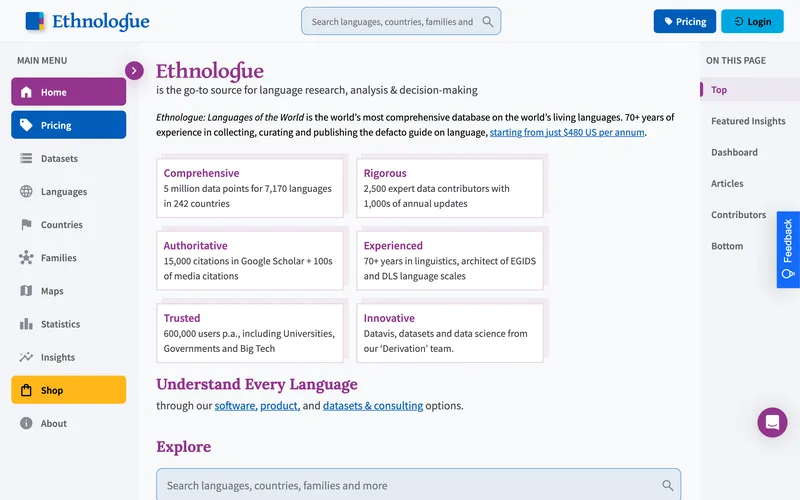
Ethnologue counts 7,170 living languages in the world, for a population of 7.684 billion people. Of those, 482 are institutional, 3,462 are stable and 3,226 are endangered.
Those labels are simple once you see them side by side:
- Institutional: schools, governments and other institutions use and support the language.
- Stable: no institution backs it, but children at home and in the community still learn it.
- Endangered: children no longer learn and use it as the norm.
That’s a striking imbalance.
Just the top 8 languages by native speakers, Mandarin through Japanese, add up to about 2.9 billion people. That’s more than a third of everyone on the planet, spread across only 8 of the 7,170.
Meanwhile, nearly half of all languages are endangered. The same dashboard lists 448 languages as extinct: no longer used, with no one keeping an ethnic identity tied to them.
So the rarest languages aren’t the hard ones or the obscure ones. They’re the ones parents stopped passing on.
That dashboard also counts 430 million deaf people worldwide and puts literacy at 87%.
It’s a useful reminder. Sign languages are full languages too, but spoken-language rankings like this one leave them out.
The Language Families Behind the Top 10
7 of the top 10 native languages belong to the Indo-European family, from Spanish and English to Hindi and Russian. The rest come from 4 other families: Sino-Tibetan for Mandarin, Japonic for Japanese, Turkic for Turkish and Austroasiatic for Vietnamese.
Indo-European splits into branches you’ll see over and over:
- Romance: Spanish, Portuguese, French
- Germanic: English, Standard German
- Indo-Aryan: Hindi, Bengali, Western Punjabi, Marathi, Urdu
- Balto-Slavic: Russian
Why care?
Because family is a decent hint at how hard a language will feel to you. If you speak English, Germanic and Romance languages share more vocabulary and grammar with what you already know.
Look past the top 10, and 4 more families join in:
- Dravidian: Telugu (83 million) and Tamil (79 million)
- Afroasiatic: Egyptian Arabic, Levantine Arabic and Hausa
- Austronesian: Indonesian (78 million) and Javanese (69 million), both from Southeast Asia
- Koreanic: Korean (82 million)
So the 50-million club spans at least 9 families, even though one family holds most of the top spots.
You can trace these branches on a language family tree, then compare how they rank on language difficulty for English speakers.
Which of the Most Spoken Languages Should You Learn?
The most spoken language worth learning depends on where you’ll use it. For most US learners, Spanish is the most practical of the big 3: it has 487 million native speakers, it’s official in 21 countries per Middlebury, and you can use it at home.

Here’s a quick way to match the rankings to your goal:
- You want people to talk to this month: Spanish, since you can find speakers in most US cities and across Latin America, for work or tourism.
- You’re looking at career reach: check which languages matter for business and trade in your field before picking.
- You’re planning for the long haul: weigh today’s counts against the best languages for the future, since rankings shift over decades.
- You’re torn between two: a head-to-head like Spanish or Japanese shows how a 487 million vs 124 million gap plays out in real use.
Mandarin is the bigger prize by native speakers, at 988 million, but most of them live in China. Hindi, with 347 million, works the same way for India.
So the right big language depends on the people and culture you want to reach.
Speaker count is only one input.
The best language to learn for you also depends on time, difficulty and what you actually enjoy watching or reading.

If ease matters most, Spanish scores well there too; here’s how easy Spanish is for English speakers. And if you plan to start learning on an app, it helps to know the best language to learn in Duolingo before you pick a course.
Big languages also pay off beyond travel. The economic benefits of multilingualism show up in hiring and pay, not just in conversation.
Pick the language you’ll actually use, then let the rankings break a tie.
Want the full decision framework? Start with what language you should learn, then come back here for the numbers.
Frequently Asked Questions
What are the top 5 languages spoken in the world?
By native speakers, the top 5 languages in Ethnologue’s 2026 figures are Mandarin Chinese (988 million), Spanish (487 million), English (372 million), Hindi (347 million) and Portuguese (252 million). Count second-language speakers too, and English moves to the top of the list.
What is the #1 language in the world?
The #1 language in the world is English by total speakers and Mandarin Chinese by native speakers, with 988 million first-language speakers in 2026. Use the native figure when you mean people who grew up with the language, and the total when you mean everyone who can use it.
What are the 20 most spoken languages?
The 20 most spoken languages by native speakers in Ethnologue’s 2026 figures run from Mandarin Chinese (988 million) down to Urdu and Indonesian (78 million each), with Spanish, English, Hindi, Portuguese, Bengali, Russian and Japanese near the top. Standard German and French follow at 76 million each.
What is the rarest language?
Ethnologue doesn’t name one rarest language, but it classes 3,226 of the world’s 7,170 living languages as endangered, meaning children no longer learn them as the norm. It also lists 448 languages as extinct.
How many people speak Mandarin Chinese?
Mandarin Chinese has 988 million native speakers in Ethnologue’s 2026 figures, the most of any language. The CIA World Factbook’s 2018 estimates put it at 12.3% of the world’s population, about 1 in 8 people.
Is Hindi more spoken than English?
Hindi has slightly fewer native speakers than English, 347 million to 372 million in Ethnologue’s 2026 figures. English pulls much further ahead once second-language speakers are counted.
Is Spanish more spoken than English?
Spanish has more native speakers than English, 487 million to 372 million in Ethnologue’s 2026 figures. English has far more second-language speakers, so it comes out ahead when you count everyone who speaks it.
What is the most spoken language in the world in 2026?
The most spoken language in the world in 2026 is still English by total speakers and Mandarin Chinese by native speakers, at 988 million. Spanish holds second place by native speakers with 487 million.