Stephen Krashen’s theory of how people pick up a second language has 5 hypotheses.
Only 1 thing in it gets called “the crucial and necessary ingredient” in Ricardo Schütz’s long-running summary of the theory.
It isn’t grammar drills. It’s comprehensible input.
The best part? You don’t need a class or a course to use it.
You need the right material at the right level, plus a simple way to tell when you’ve found it.
What Is Comprehensible Input?
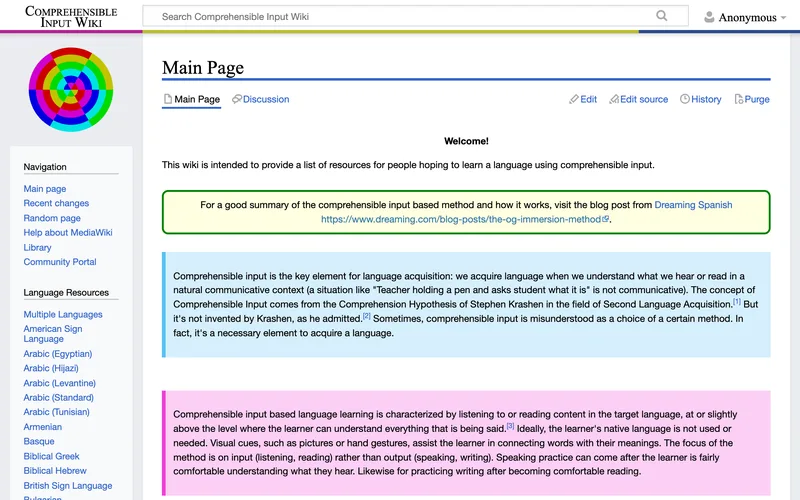
Comprehensible input is language you hear or read and mostly understand, even when some of the words are new. The Comprehensible Input Wiki, a reference site, describes it as content at or slightly above the level where you understand everything.
“Input” just means what comes in: listening and reading. “Output” is what goes out, which is speaking and writing.
The “comprehensible” part is what makes it work. You get the message from context, like a picture, a gesture or a plot you already know, and the new words ride along with it.
Here’s an example:
Say you’re learning Spanish, and a friend holds up a mug and asks, “¿Quieres más café?” You know café, the mug does the rest, and más sticks a little better every time you hear it.

So comprehensible input isn’t a brand or an app. It’s a quality of the material, and you can find it in almost any show, podcast or book at the right level.
Who Came Up With Comprehensible Input?
Linguist Stephen Krashen of the University of Southern California made comprehensible input famous through his Input Hypothesis. It’s one of the 5 hypotheses in his theory of second language acquisition.
Since 1980, Krashen has published well over 100 books and articles. He’s also given over 300 university lectures in the US and Canada, according to that same summary.
The summary has been online since April 1998 and was last revised in October 2019.
What Does i + 1 Mean?
Krashen’s i + 1 formula describes input one step beyond your current stage, with “i” standing for the level you’re at now. Input at i + 1 lets you follow the message while still meeting something new.
Sounds hard to aim at, right?
Krashen’s answer is that you don’t have to hit it exactly. Plenty of natural, meaningful input will include some i + 1 for whatever level you’re at.

Here’s how the 3 zones feel:
- At i (too easy): you understand every word, so nothing new sticks.
- At i + 1 (just right): you follow the story and can guess the new parts from context.
- Far above i (too hard): you catch a few words and lose the thread, so it’s mostly noise.
In other words, if you’re bored, move up a level. If you’re lost, move down.
What Are Krashen’s 5 Hypotheses?
Stephen Krashen’s theory of second language acquisition has 5 main hypotheses: acquisition-learning, the monitor, input, the affective filter and natural order, per Schütz’s summary. The Input Hypothesis sits at the center, and the other 4 explain why comprehensible input matters so much.
1. Acquisition vs. Learning
Acquisition is the subconscious process children use to pick up their first language. Learning is conscious knowledge about a language, like grammar rules.
Krashen treats learning as less important than acquisition. That’s why input gets so much weight: it feeds the acquired system, the one your sentences actually start from.
2. The Monitor
The monitor is your learned grammar acting as an editor. It only kicks in when 3 conditions are met: you have time, you’re focused on correctness, and you know the rule.
That helps explain why you can ace a written quiz and still freeze in a fast conversation. In real talk, you rarely have all 3.
3. The Input Hypothesis
This is the i + 1 idea from above: you pick up language by understanding messages a bit beyond your level. It covers acquisition only, not learning.
4. The Affective Filter
The affective filter is a mental block that stress and low confidence put between you and the input. Low motivation, low self-esteem and anxiety can raise it, and when it’s up, comprehensible input doesn’t get used for acquisition, Schütz explains.

So if a class makes you tense, the input may not land. Pick material and settings that feel relaxed.
5. The Natural Order
The natural order hypothesis says grammar structures get acquired in a predictable order, some early and some late. It rests on studies from 1974 to 1980, including one by Dulay and Burt, which suggested the order holds no matter a learner’s age or first language.
Krashen draws a surprising conclusion from it. He rejects teaching grammar in a fixed sequence when the goal is acquisition.
Does Comprehensible Input Work?
Comprehensible input sits at the core of Krashen’s theory, which Schütz’s summary calls well accepted, with a large impact on second language research and teaching. Krashen’s view is that the best methods supply comprehensible input in low-anxiety settings, with messages learners really want to hear.
So is it the best way to learn a language? I’d call it the part you can’t skip on the way to fluency, not the whole plan.
Even Krashen allows that studying grammar can have some value. Any benefit, though, depends a lot on the learner already knowing the language fairly well.
The theory also doesn’t come with a stopwatch. For a realistic target, work out how long a language takes at your weekly hours.
Key Takeaway: make understandable input the biggest block of your study time, then fit grammar and vocabulary around it. The steps to learn a new language show where each piece goes.
Comprehensible Input Examples for Every Level
Comprehensible input examples include picture books, kids’ shows, learner podcasts, graded readers, familiar TV series and novels, depending on your level. The Comprehensible Input Wiki even sorts graded readers for some languages by level band, such as A1-A2 and B1-B2.
Here’s what works at each stage:
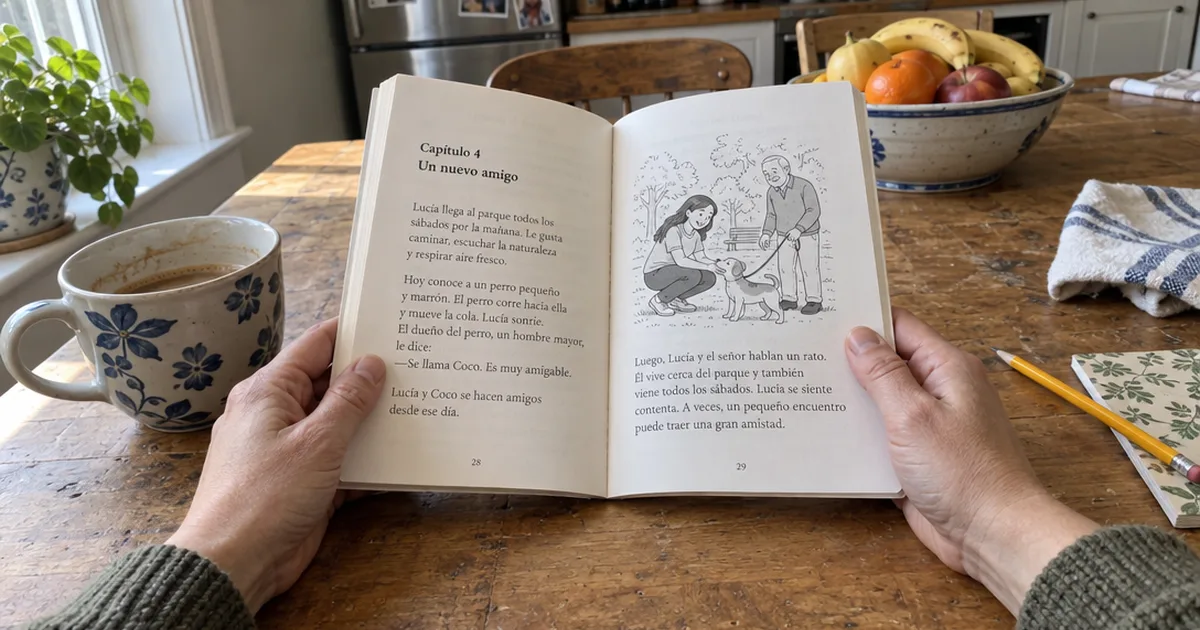
- Beginner: picture books, kids’ shows, slow podcasts made for learners, and graded readers, which are books written with limited vocabulary for each level.
- Intermediate: podcasts for learners, shows you’ve already seen in English, and songs you can learn a language with by reading the lyrics as you listen.
- Advanced: podcasts for native speakers, novels, news and films with no subtitles at all.
TV deserves its own mention, because a plot you already know does a lot of the decoding for you. You can learn from TV shows by starting with familiar series and rewatching short scenes.
Reading works the same way. If you’re learning French, start with short French texts to read at your level before moving to novels.
How to Tell If Input Is at Your Level
Comprehensible input is at your level when you can follow what’s happening without stopping, even if some words slip past you.
Here’s the quick check I’d run on any episode, podcast or chapter:
- You can sum up what happened in 1 or 2 sentences.
- You can guess most new words from the scene or the sentence around them.
- You’d keep going even without a dictionary.
- You feel curious, not tense.
If 2 or more are a no, step down a level. If all 4 are an easy yes and nothing feels new, step up.
How to Get Started With Comprehensible Input
To get started with comprehensible input, pick one source you’d enjoy anyway, start a little below your level, and give it a daily slot.

Then build the habit in this order:
- Pick something you actually like. Interest keeps your affective filter low, and you’ll come back to it tomorrow.
- Start easier than feels necessary. Early wins build the confidence that keeps input landing.
- Turn on subtitles in the language you’re learning. You’ll read and hear each line at once, so you can match fast speech to the words on screen.
- Rewatch or relisten. A second pass lifts your comprehension, and repeated words start to stick.
- Look up only vocabulary that blocks the story. Any other word can wait until you meet it again in a new sentence.
- Move up when it feels easy. Run the 4-point check above every couple of weeks.
Want more techniques? These comprehensible input strategies go deeper on each step, and full language immersion is the next level up once a daily habit feels normal.
Is Comprehensible Input Enough, or Do You Need to Speak?
Comprehensible input comes first, and speaking follows when you’re ready, so you don’t need to force early conversation.
That matches Krashen’s view, as Schütz’s summary explains it: good methods let learners produce when they’re “ready.”
That doesn’t mean staying silent forever. The Comprehensible Input Wiki suggests speaking once you understand what you hear fairly well, and writing once reading feels easy.
A quiet start is normal, too. It matches the early stages of language acquisition, where understanding runs well ahead of speech.
When you do start a conversation, pick patient partners. In the summary’s words, “conversations with sympathetic native speakers who are willing to help the acquirer understand are very helpful.”

To bridge the gap on your own, try shadowing a native speaker: play one line, pause, then repeat it in the same rhythm.
Comprehensible Input by Language
The method works in any language, but the best starting material doesn’t carry over. Pick yours:
- Spanish: where to find Spanish input by level.
- French: channels and podcasts for French comprehensible input.
- German: starting points for German input.
- Japanese: easy listening for Japanese learners.
- Korean: beginner-friendly Korean input.
- Chinese: graded listening for Mandarin Chinese input.
- Arabic: where to start with Arabic comprehensible input.
- Russian: level-sorted Russian input.
- English: materials for English learners, plus English podcasts for learners.
Start Tonight
Comprehensible input is the one ingredient Krashen calls necessary, so let it fill most of your study time.
Tonight, pick one show or podcast in your target language that feels slightly too easy, and get through a full episode.
Frequently Asked Questions
What is input in language learning?
Input in language learning is everything you take in by listening or reading, while output is what you produce by speaking and writing. Comprehensible input is the part of that input you mostly understand, and Krashen sees it as the part that drives acquisition.
What is Stephen Krashen's comprehensible input theory?
Krashen’s comprehensible input theory, the Input Hypothesis, says you acquire a language by understanding messages one step beyond your current level, written as i + 1. It’s one of the 5 hypotheses in his theory of second language acquisition.
Can you learn a language by watching TV with subtitles?
TV counts as comprehensible input when you can follow the story, and subtitles in the language you’re learning can help keep it understandable. Start with a show you’ve already seen in English, so the plot carries you through the new words.
How do teachers use comprehensible input in the classroom?
Teachers use comprehensible input by teaching in the target language at a level students understand, with pictures, gestures and simple speech carrying the meaning. In Krashen’s view, as Ricardo Schütz summarizes it, even a grammar lesson becomes comprehensible input when it’s taught in the target language and students understand it.