italki lists 1,240 Japanese teachers, yet you can reach your first real conversation without paying any of them.
A free grammar guide, a flashcard app and native speakers on exchange apps cover most of what a beginner needs.
The catch is the order you learn things in.
If you’re still deciding whether to start, the hard and easy parts for English speakers are worth a look first.
Here’s how to learn Japanese in 7 steps, in the order that works, with free tools for most of them.
Best for: adult beginners studying on their own. Skip it if you already read kana and finished a first textbook.
Cost: Free to start. A paid tutor is optional.
Time: This week for your first characters, then 20 to 30 minutes a day.
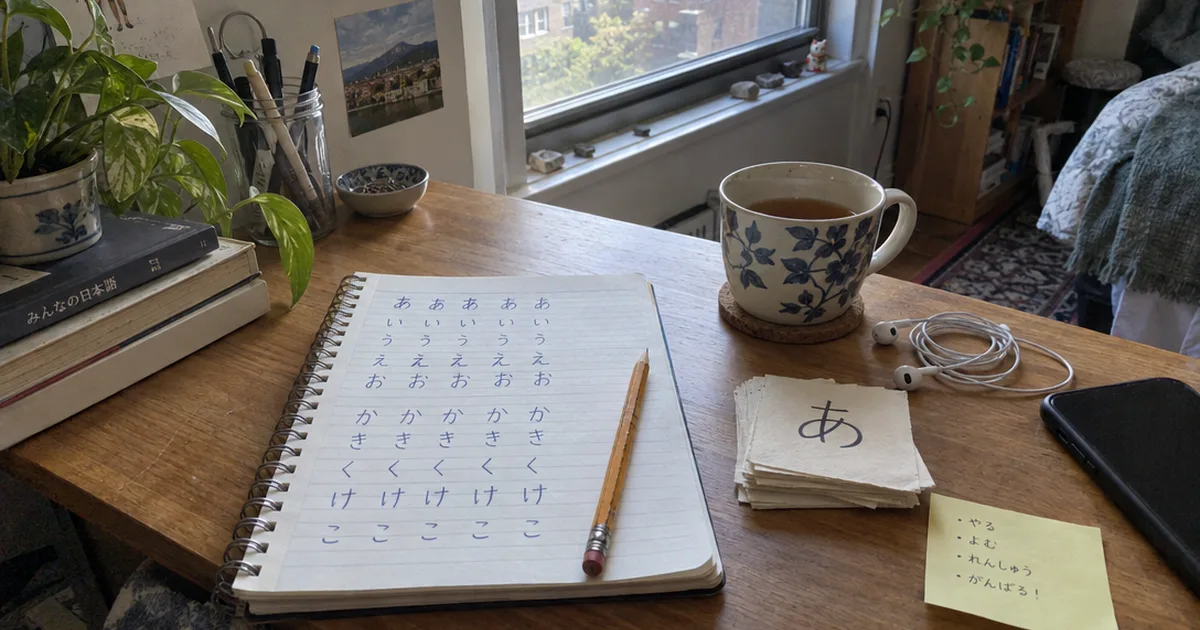
First step: Learn the 5 Japanese vowel characters today: あ, い, う, え, お.
How to Learn Japanese Step by Step
Learning Japanese works best in 7 steps: set a goal, learn kana, fix your sounds, pick one grammar resource, build vocabulary, listen daily, then speak. Each step builds on the one before, the same logic as the general steps to learn a language for any second language.
Step 1: Pick Your Goal and a Daily Slot
Your goal decides what you learn first. Travel to Japan means survival phrases and katakana early, anime and manga mean listening and reading, and long-term fluency means all four skills from the start.
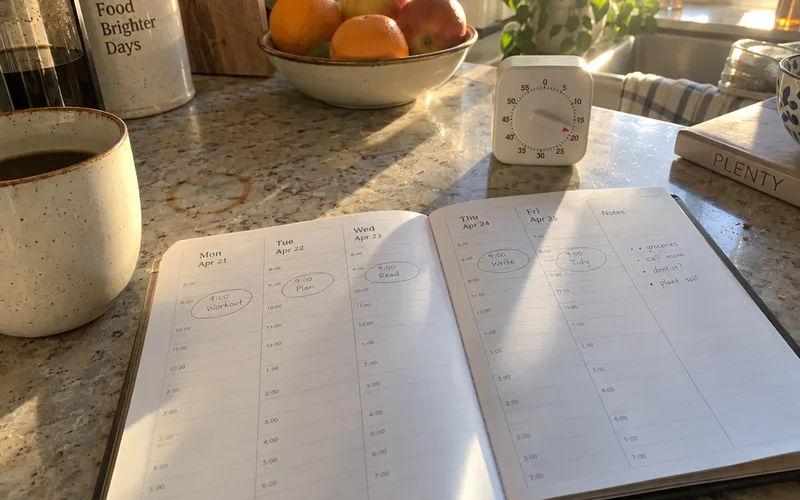
So write your goal down in one sentence. Then pick a daily slot you can keep, even if it’s only 20 minutes.
How long it takes to learn Japanese depends on that daily time and how far you want to go. The Japanese learning timeline walks you through working out your own estimate.
Step 2: Learn Hiragana First, Then Katakana
Of the 3 Japanese writing systems, hiragana comes first because it writes native Japanese words and the grammar particles. The other two are katakana, a second syllabary, and kanji, built from Chinese characters.
Hiragana and katakana each have 46 basic characters, so this part is smaller than it looks. A focused kana study plan gets you through both, and kana learning apps make the drilling feel less like homework.
Write each character by hand while you say it, and use mnemonics for the ones that won’t stick. A writing practice book gives you grids for stroke order, and real hiragana practice words turn single sounds into vocabulary fast.
Drop romaji as soon as you can. Romaji, the romanization of Japanese in Latin script, feels like a shortcut but keeps you reading English sounds into Japanese.
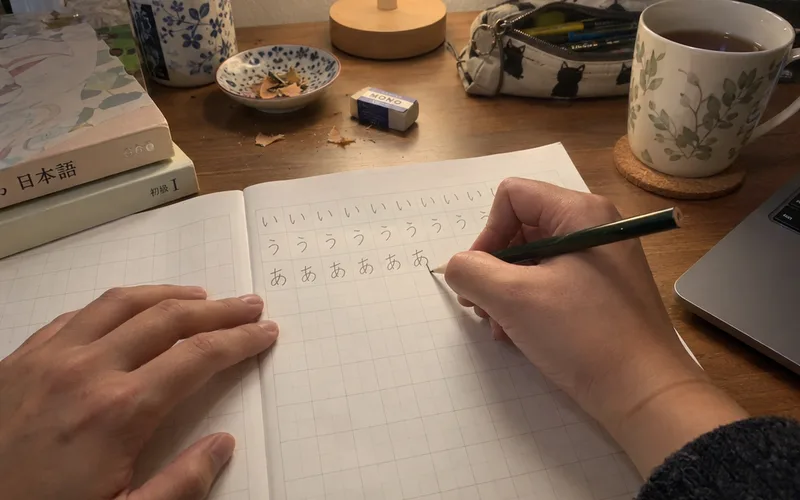
Use a Japanese alphabet chart only while you check yourself, then let it go.
Katakana comes second. It mainly writes loanwords and foreign names, like コーヒー (koohii, coffee).
Step 3: Get the Sounds Right Early
Japanese pronunciation is simpler than English in one big way. There are 5 vowel sounds, a, i, u, e and o, and each one stays the same in every word.
Most consonants pair with a vowel to form one syllable, so kana spelling is close to phonetic.
The tricky part is pitch accent. Japanese uses pitch rather than stress, so the same sounds can mean different words with a different intonation.
You don’t need to master pitch accent as a beginner. Just listen for it, copy native speech and record yourself once a week.
Step 4: Pick One Grammar Resource and Stick With It
Japanese sentence structure puts the verb at the end, in Subject-Object-Verb order, not the Subject-Verb-Object of English. Small particles after nouns, such as wa (topic), ga (subject) and o (direct object), mark what each word is doing.
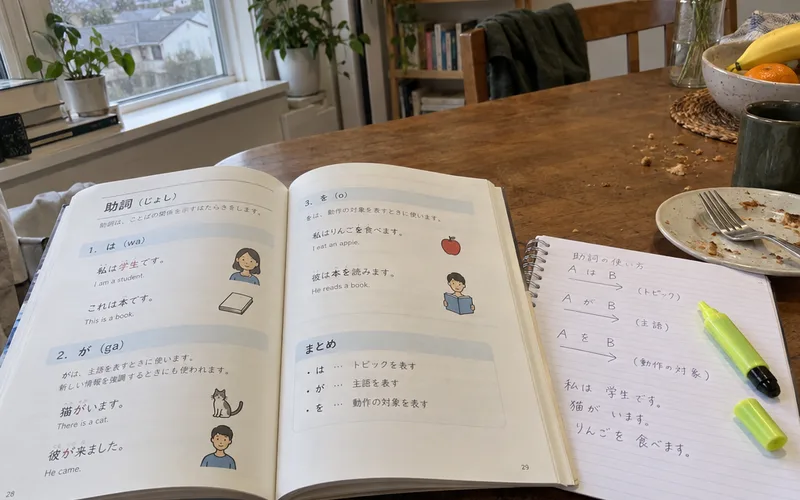
Verbs conjugate for tense and politeness, and adjectives change form too, so a structured resource matters. Tae Kim’s Guide to Learning Japanese is free, and its grammar guide also comes as an Android and iOS app.
The same site lays out a simple order: kana first, then vocabulary with kanji and grammar. After that, you practice with material you actually enjoy.
If you’d rather work from a textbook, compare the best books for Japanese or read this Marugoto online course review before you pay for anything.
Here’s the rule: pick one and finish it. Jumping between textbooks leaves gaps you won’t notice until a sentence falls apart.
Step 5: Build Vocabulary and Kanji With Spaced Repetition
Kanji are logograms adopted from China that stand for meanings, and most have more than one reading. Learn each kanji inside a real word, not as a lone symbol, so the reading sticks to a context you’ll actually use.
Spaced repetition does the scheduling for you. A flashcard app shows each card right before your memory drops it, so memorization takes fewer reviews.
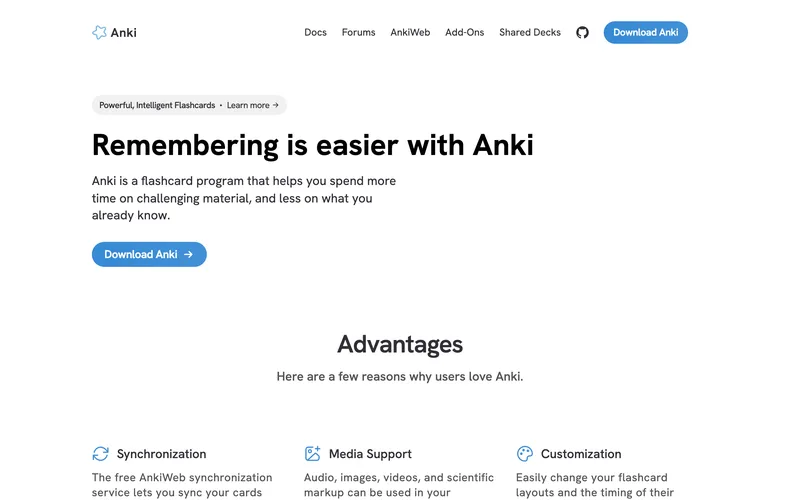
Anki is a flashcard program built around this idea. Set it up with this Anki guide for Japanese, then add one of the best Japanese Anki decks so you’re not typing cards for weeks.
Keep new cards to a number you can review every single day. Missing days is what makes the review pile scary.
Step 6: Listen and Read Every Day
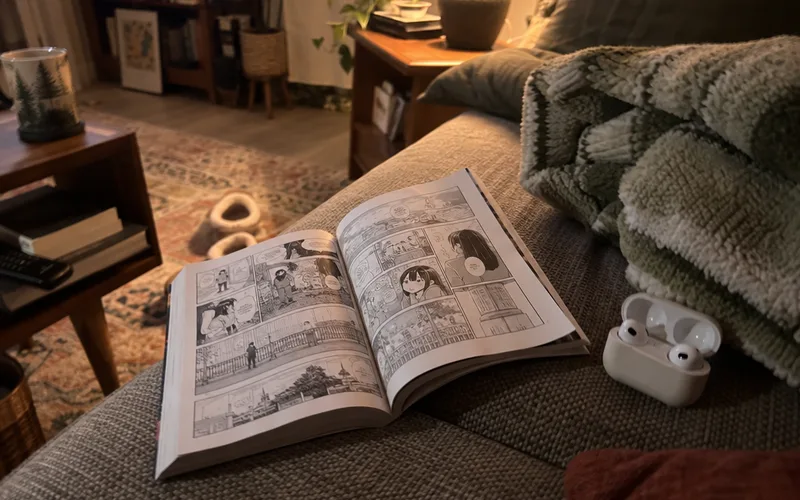
In language acquisition, daily input turns words from your deck into words you understand at full speed. Watch anime or YouTube with Japanese subtitles instead of a translation, play beginner podcasts on your commute and read manga with furigana, the small kana printed over kanji.
The key is input you mostly understand. That’s the idea behind comprehensible input for Japanese, and it’s why free graded readers work so well at this stage.
Want something lighter on tired days? A few of the best games for learning Japanese still count, as long as the text is in Japanese.
Step 7: Start Speaking Early
Speaking feels scary, so it’s easy to put off. Start once you can say a few simple sentences, not after you “know enough”.
A language exchange pairs you with a native speaker of Japanese who wants to learn your language. Tandem’s App Store listing shows the app is free with in-app purchases.
You trade practice time, so neither of you pays.
Here’s a first message you can send:
Hi! I’m learning Japanese and can help with English. Could we chat 15 minutes in each language this week?
Want more structure? A speaking immersion course or a paid tutor gives you a plan and real corrections.
What a 30-Minute Japanese Study Day Looks Like
A 30-minute Japanese study day can cover 4 parts: about 10 minutes of Anki reviews, 10 minutes with your grammar resource, 5 minutes of listening and 5 minutes of speaking out loud. Treat those splits as a starting point, and shift time toward whatever your goal needs most.
Here’s how that could look on a weekday:
- Clear your Anki reviews over breakfast.
- Read one grammar point and write 3 example sentences.
- Play a short Japanese video or podcast on your commute.
- Say your 3 sentences out loud, or send them to an exchange partner.
On weekends, swap the grammar block for a longer show or a 30-minute exchange chat. That way your week mixes study with real Japanese, not just drills.
What You Need to Learn Japanese
Learning Japanese takes 3 tools at the start: a grammar resource such as Tae Kim’s free guide, a flashcard app such as Anki and a language exchange app such as Tandem. Everything else is optional.
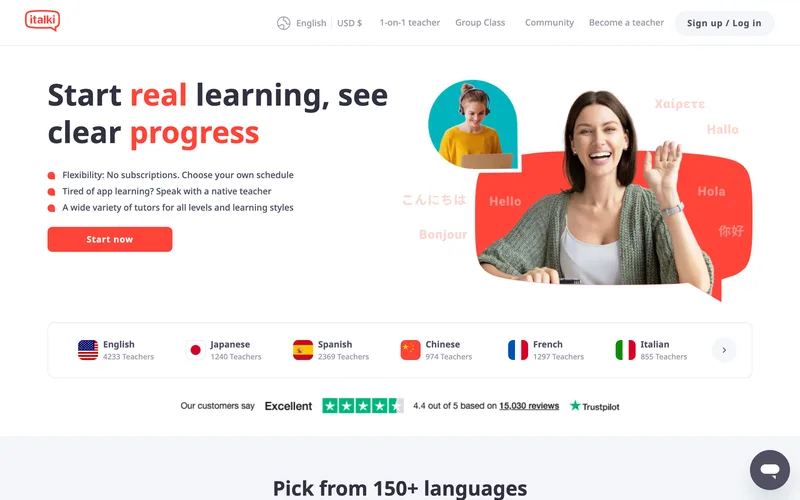
Tutors are the main paid extra. italki says lessons are pay as you go, and teachers set their own prices.
Lessons there run 30 or 45 minutes, and you can book up to 90.
So you can test a tutor once without a subscription. If a single lesson doesn’t fit your budget, start with these free Japanese online classes and a list of free Japanese resources instead.
AI tutors are a newer middle ground for speaking drills. Compare the AI apps for Japanese before you pay for one.
What Do N5 to N1 Mean in Japanese?
N5 to N1 are the five levels of the Japanese-Language Proficiency Test (JLPT), from N5, the beginner level, up to N1, the most advanced. The JLPT gives you a clear way to track progress, even if you never sit the exam.
For a first target, the N5 Japanese level shows what a beginner is expected to know. If you need a certificate for school or work, compare the JLPT with other language proficiency tests before you pick one.
Common Mistakes When Learning Japanese
The most common mistakes when learning Japanese are leaning on romaji, putting off kanji and relying on one app. Each one feels faster at first, then slows you down once sentences get longer.
Leaning on romaji. It keeps you reading the Latin alphabet and bends your pronunciation toward English, so switch to kana in week one.
Putting off kanji. Real Japanese literacy needs kanji, so start simple ones as soon as kana reads smoothly.
Relying on one app. Apps are great for streaks, but they can’t replace grammar and real input.
A Duolingo Japanese review shows where one app fits.
Waiting to speak. Your first exchange chat will be an awkward experience, and the second one is easier.
Frequently Asked Questions
Is it better to learn hiragana or katakana first?
Hiragana is better to learn first, because it writes native Japanese words and the particles in almost every sentence. Learn katakana next, once hiragana reads quickly, since katakana mainly writes loanwords and foreign names.
How can I learn Japanese myself?
You can learn Japanese by yourself with mostly free tools: Tae Kim’s free guide for grammar, Anki for vocabulary and kanji, Japanese shows and podcasts for listening, and a Tandem partner for speaking. Follow the steps in order and add a paid tutor only when you want structured feedback.
How to learn Japanese kanji fast?
Kanji go faster when you learn each one inside a real word and review it with spaced repetition in Anki, instead of drilling single characters. Pick high-frequency kanji from your textbook and the shows you watch first.
What is N1, N2, N3, N4, N5 in Japanese?
N1 to N5 are the five levels of the Japanese-Language Proficiency Test (JLPT), where N5 is the beginner level and N1 is the most advanced. If you’re starting from zero, N5 is the level to read about first.
Is Duolingo enough to learn Japanese?
Duolingo works best as a supplement to Japanese study, not the whole plan. Pair it with one grammar resource, Anki and daily listening and speaking so you learn why sentences work, not just which tile comes next.
How to learn Japanese for travel?
Learning Japanese for travel means putting hiragana, katakana and survival phrases first, such as greetings, ordering food and asking for directions. Katakana matters early because it writes loanwords like コーヒー (koohii, coffee).
Is Japanese similar to Chinese?
Japanese is similar to the Chinese language in writing, because kanji are characters adopted from Chinese. Japanese grammar is different, though: the verb comes at the end of the sentence and particles mark each word’s role.
Final Thoughts
The order beats the app: kana, sounds, one grammar resource, kanji in words, then daily listening and speaking.
Learn your first 5 hiragana tonight and book your first exchange chat before the month ends.