
Most people who quit a new language don’t lack talent. They lack a plan for what to do on day 1, day 30 and day 300.
In this guide, I’ll walk you through the 10 steps to learn a new language that work for most adult learners, in order, with the first move for each one. You’ll also get honest timelines, free tools and the most common way each step goes wrong.
Let’s dive right in.
Where to Start: A Quick Picker
You don’t have to start at Step #1. Use this list to jump to the step that fits where you are today:
- Brand new and haven’t picked a language? Start with Step #1.
- Picked a language but keep quitting? Go to Step #2 and build the routine first.
- Know some words but can’t follow real speech? Jump to Step #4.
- Understand a lot but freeze when you talk? Go straight to Step #6.
- Stuck at the same level for months? Read Step #10.
Step #1: Pick Your Language and a 90-Day Goal
Your first job is to choose one language and one goal you can check in 90 days. “Learn Spanish” is a wish, while “chat for five minutes with my Spanish-speaking coworker by March” is a goal.
This step fits everyone, and it costs nothing but an hour of thinking. Skip it only if you already have a language and a dated goal written down.
Here’s how to do it:
- Write down why you want the language: travel, work, family, a partner or the shows you love.
- If you’re still torn between two options, work through which language to learn before you pay for anything.
- Turn your reason into one task you could do in 90 days, like “follow a cooking video without subtitles.”
- Put that date on your calendar tonight.
Your choice also sets the length of the road. The Foreign Service Institute (FSI), which trains US diplomats, groups languages by how long English speakers take to learn them.
According to Big Think’s report on the FSI system, English speakers should reach reading and speaking proficiency in its easiest group after about 24 weeks of intense study. That’s full-time classroom study, so a 30-minute daily habit will take a good deal longer.
Which languages are in that easy group? Big Think lists French, Spanish, Portuguese, Italian and Romanian, plus Dutch, Danish, Norwegian and Swedish, as Category I on the FSI scale.
If a fast payoff matters most to you, a guide to how hard each language is can help you weigh that against your reasons.
Once you’ve chosen, each language has its own path on this site. There’s a full track for learning Spanish, another for learning French and one for studying Japanese, from its writing systems to graded readers.
You’ll also find guides to American Sign Language, which has its own grammar and culture. And if English is the language you’re learning, check how hard English is for your first language, then start with the resources for English learners.
The catch: big goals feel exciting on day one and crushing on day 40. The fix is to keep only one 90-day goal at a time and set the next one when you hit it.
Step #2: Build a 30-Minute Daily Routine
Next, set up a routine you can repeat on your worst day. I recommend 30 minutes a day over a three-hour weekend session, because short daily practice keeps the words fresh and builds the habit.
This fits anyone with a job, kids or school. Skip it only if you’re enrolled in a full-time course that already sets your schedule.
It costs nothing, and you’ll feel the payoff within two or three weeks, when starting stops feeling like a chore.
Here’s a simple 30-minute split to start with:
- 5 minutes: review flashcards (Step #3).
- 15 minutes: listen to or read something you mostly understand (Step #4).
- 5 minutes: grammar from a course or app (Step #5).
- 5 minutes: speak out loud (Step #6).
Your first step today: pick a trigger you already do every day, such as your morning coffee or your commute. Then attach the session to it and set a phone reminder for that time.
Here’s an example:
Say you work 9 to 5 and have two kids. You do flashcards on your phone while the coffee brews, then play a learner podcast on the drive to work.
At lunch you read one page of a graded reader. On the drive home, you repeat a few phrases from the podcast out loud.
That’s 30 minutes without carving out a single extra block of time.
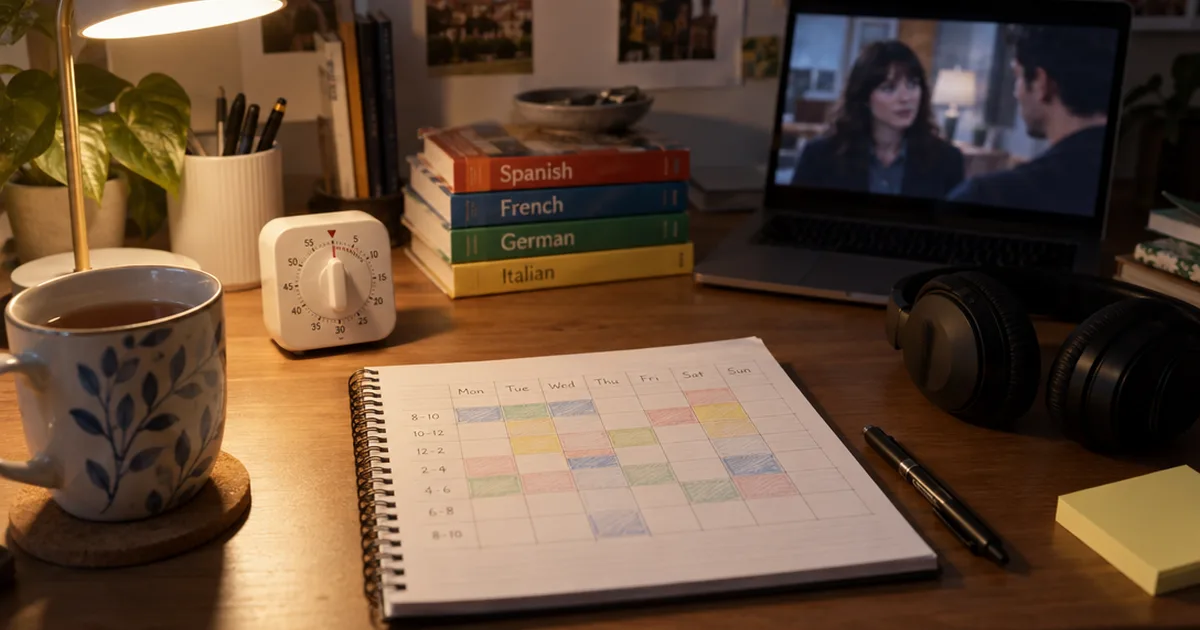
Want a fuller template? The language learning plan walks through weekly and monthly versions of this schedule.
The catch: one missed day turns into a missed week. The fix is a “minimum day” of five minutes of flashcards, which still counts and keeps your streak alive.
Step #3: Learn Common Words With Spaced Repetition
Now start on vocabulary, beginning with the most common words. You’ll hear “the,” “want” and “tomorrow” thousands of times before you ever need “stapler.”
Spaced repetition is the tool for this. Spaced repetition shows you a word just before you’re likely to forget it, then waits longer each time you remember it.
This step fits every learner. It costs nothing if you use Anki, a free flashcard program for computers, and you’ll notice words sticking within the first two weeks.
Set it up in four moves:
- Download Anki, or use the review feature in the app you already like.
- Search Anki’s shared decks for “[your language] frequency” to find a deck of common words.
- Add 10 new cards a day, no more at first.
- Do your reviews every day before adding anything new.
For a click-by-click walkthrough, see how to use Anki for language study. The spaced repetition guides also cover building decks and memorizing whole sentences.
Pro Tip: put a full sentence on each card instead of a single word. You’ll learn grammar and word order for free while you review.
For a Spanish learner, a good card might say “Quiero un café, por favor” on the front and “I want a coffee, please” on the back. Add a short note that “quiero” comes from “querer,” to want, and you’ve learned a verb, a noun and a polite phrase at once.
The catch: adding 50 new cards a day feels productive until your reviews pile up to an hour. Hold new cards at 10 to 15 a day, and cut back the moment reviews take more than 15 minutes.
Step #4: Get Lots of Input You Can Understand
This is the step most advice on how to learn a foreign language rushes past, and it’s the one that does the heavy lifting. Spend the biggest part of each session listening to and reading material you can mostly follow.
Language teachers call this comprehensible input. That just means content slightly above your level, where you understand most of it and can guess the rest from context.
Here’s why it matters: you can’t speak words you’ve never heard. Input fills your head with real sentences, real rhythm and real pronunciation, so speaking gets easier later.
It’s cheap, too. Podcasts, YouTube and library e-books cost nothing, and a streaming service you already pay for counts.
Build your input in this order:
- Start with material made for learners: slow podcasts, graded readers or YouTube channels made for beginners.
- Pick topics you already enjoy, because you’ll stick with them longer.
- Move to shows and films once beginner content feels easy.
- Turn on subtitles in the language you’re learning when you can, not in English.
Let me show you what that looks like. Say you’re learning Spanish and you know about 500 words.
A slow learner podcast about daily life works today, and a kids’ cartoon might work next month. A fast-talking crime drama can wait until you’re further along.

TV and film work well once you’ve got a few hundred words. You can learn from TV shows by picking series with lots of everyday dialogue and rewatching short scenes until you follow them.
For the theory and more ways to find input, head to the comprehensible input hub.
All that listening and reading is real mental work, and it may pay off beyond the language. Medical News Today reports on a Lund University study in which committed language students showed growth in the hippocampus, a brain region tied to learning.
The catch: native content that’s too hard turns into background noise. If you understand less than about half of it, drop down a level until you can follow the story.
Step #5: Learn Just Enough Grammar
Grammar matters, but it shouldn’t be the main event. Spend about five minutes a day on it, and use it to make sense of what you’re already hearing.
This fits every learner. Skip heavy grammar study only if you’re under real time pressure to speak, such as a trip to Italy next month, where everyday phrases will help you more.
To keep it light, learn in this order:
- Learn the basic sentence order first: who does what to whom.
- Learn how to ask a question and how to say “not.”
- Learn the present tense of the 10 most common verbs.
- When a pattern in your input confuses you, look it up then, not before.
For example, say you keep hearing a word at the end of Spanish sentences that you can’t place. Look it up once, write one example sentence on a flashcard, and move on.
A beginner textbook or the grammar notes inside your app are enough for the rest. If you like a printed book, the language book guides compare textbooks and grammar references by level.
The catch: waiting to speak until your grammar is perfect. Native speakers will understand “Yesterday I go to the store,” so speak now and fix the errors as you notice them.
Step #6: Start Speaking in Week One
Speak out loud from the first week, even if it’s only to yourself. Speaking is a physical skill, and your mouth needs practice making the new sounds.
This step fits everyone and costs nothing. You’ll notice smoother speech within a month of daily practice.
Try these three drills this week:
- Read your flashcard sentences out loud during reviews.
- Describe what you’re doing as you cook or drive, using the words you know.
- Record yourself for one minute, then play it back and note one sound to fix.
Shadowing is a great next step. You play a short audio clip and repeat it right after the speaker, copying their rhythm and tone.
Our shadowing technique guide shows how to pick clips and run a session.
For more solo drills, here’s how to practice speaking alone when you don’t have a partner yet.
The catch: practicing alone can make you fluent at talking to yourself and nervous with real people. The fix is Step #7, which you should start within your first three months.
Step #7: Add a Tutor or an Exchange Partner
Once you can say a few simple sentences, add real conversation. You’ve got two options, and the right one depends on your budget.
A language exchange is free. You trade time with a native speaker who wants to learn English, for example 30 minutes in each language.
An exchange fits learners on a tight budget who don’t mind a bit of awkward small talk.
A paid tutor costs money but gives you structure and corrections. A tutor fits learners who want faster progress or who freeze with strangers.

Prices vary widely by language and country, so get your own number in five minutes. Open a tutoring site, filter by your language, set the price slider to your budget and sort by reviews.
Your first step today: write a two-line profile in your new language, mistakes and all, so partners and tutors can see your level at a glance. Then compare your options in the best language exchange apps and the best tutor apps, which list what each service is good for.
Here’s how to run your first exchange session:
- Agree on the split before you start, such as 20 minutes in each language.
- Pick one everyday topic, like your weekend or your job.
- Keep a notes app open and write down every word you had to ask for.
- Turn those words into flashcards that same evening.
And here’s what to send your first tutor or partner:
“Hi! I’m a beginner in [language] and I’ve been studying for [time]. Could we spend most of our time talking slowly about everyday topics? Please correct my biggest mistakes, but not every small one.”
The catch: lessons that turn into the tutor talking while you listen. Ask for at least half of each session to be you speaking, and say so up front.
Step #8: Choose Your Tools (Apps, Books and Courses)
Notice that tools come at Step #8, not Step #1. That’s on purpose, because the best app is the one that supports your routine, not the one with the slickest ads.
Here’s how each tool type fits:
- Apps like Duolingo, Babbel and Memrise are good for a daily habit and early vocabulary. I wouldn’t count on them alone to get you to real conversation.
- Textbooks give you a clear order for grammar and are easy to review.
- Graded readers are short books written at your level, which makes them perfect input.
- Courses at a community college or online add a teacher and a schedule.
If you’re working out how to learn a new language on a tight budget, start free. Your first step today: check your public library’s website for “language learning,” because many US libraries give cardholders free access to language apps and e-books.

Not sure which app is worth paying for? Our Babbel vs Duolingo comparison covers the two most popular picks.
The app reviews section compares the rest against the methods in this guide.
The catch: collecting five apps and finishing none. Pick one app and one source of input, then add a third tool only when those are part of your daily routine.
Step #9: Track Your Progress Against Real Levels
Feelings are a bad way to judge progress, especially on a tired day. Instead, check yourself against a real scale every three months.
The most common scale is the Common European Framework of Reference for Languages (CEFR). It describes six levels, from A1 for beginners up to C2 at the top.
Track it like this:
- Read the “can do” description for each CEFR level, then pick the one that sounds most like you.
- Write three “can do” goals for the next level, such as “I can describe my job.”
- Every three months, record a two-minute talk about your week and compare it with your last one.
Our guide to proficiency levels explains each level and the tests that measure them.
What about timelines? They depend on the language and on your hours.
Big Think’s report on FSI estimates says at least 88 weeks of daily study are needed for a good grasp of Arabic. Compare that with roughly 24 weeks for Spanish, and you can see why your choice in Step #1 matters so much.
For estimates by language and study time, see how long it takes to learn a language. And when you’re ready to aim higher, the fluency guides explain what fluency really means and how to build listening and speaking at the upper levels.
The catch: only testing the skills you practice most. Check listening, speaking, reading and writing, because a gap in one will hold back the others.
Step #10: Push Through Plateaus and Stay Motivated
Somewhere around the intermediate level, progress seems to stop. That’s normal, and it usually means you’ve outgrown your current materials.
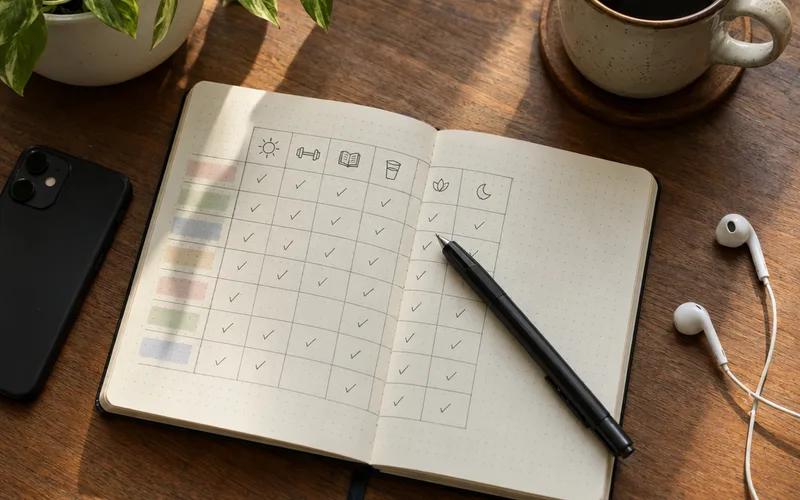
To break through, change one thing at a time:
- Swap in harder input: native podcasts instead of learner ones, or a novel instead of a graded reader.
- Add a new skill, such as writing a short diary entry each day.
- Ask your tutor to drill the mistakes you keep making.
- Change your topics so you’re learning new words again.
Our plateau guide covers more ways to spot a stall and get past it.
Motivation needs care, too. Keep a list of small wins, such as the first joke you understood or the first menu you read without help, and look at it on slow weeks.
There’s a long-term reason to keep going, as well.
Medical News Today reports on a study in which people who spoke a second language had dementia onset delayed by as long as 4.5 years. The study shows a link, not proof that learning a language prevents dementia.
For more ideas to keep your routine alive, see how to stay motivated learning a language when life gets busy.
The catch: treating a slow month as failure. Look back at your three-month recordings from Step #9, and you’ll almost always hear progress you didn’t feel.
Long Shots Worth Knowing About
These options can work well, but most readers can’t start them this month. Here they are in brief:
- Immersion programs abroad: living with a host family and studying full-time is the fastest path for many people. The deal-breaker is weeks away from work and a big upfront cost, and our list of immersion programs for adults shows what’s out there.
- Moving abroad: total immersion, but it’s a life change, not a study method.
- Intensive full-time courses: they match the FSI’s study model, but few working adults can free up that many hours.
Your First Step This Week
Learning a new language comes down to a few simple steps done every day for months, not a secret method. Pick your language and a 90-day goal this week, then do 30 minutes tomorrow.
Which step are you going to start with today?